Product discovery and user research are among the big trends on product teams: many books are devoted to them, podcast episodes are recorded about them and conferences are dedicated to them all over the world.
Yet the difference between product discovery and user research isn't always clear. It's subtle, but important: product discovery is about determining which problem your product solves. User research is about understanding how your product solves that problem for users.
Product discovery
In the early stages of a startup, it's essential to focus on product discovery. This is the phase where you work out which problem your product solves. You're looking for a problem that is both important and poorly addressed.
The product discovery process
This process aligns a product's features with the real needs and expectations of its target users. Here are its main components:
- Identify user needs and problems: the first step is in-depth research to spot the needs, problems and opportunities of the target market. It can draw on different methods: surveys, interviews, analysis of user feedback.
- Analyze the market and the competition: understanding the competitive landscape helps you spot the gaps the market has left open. That means analyzing competing offerings, their strengths, their weaknesses and their positioning.
- Ideation and conceptualization: based on the insights gathered, teams brainstorm features or solutions that address the identified needs and market gaps.
- Prototype development: quickly building prototypes, iteratively, lets you visualize and test the feasibility of the solutions you have in mind. This step is essential for getting early feedback and course-correcting.
- User validation: prototypes are tested with real users to validate hypotheses, refine the concept and make sure it meets their expectations. You observe their interactions, gather their feedback and spot what needs improving.
- Prioritization and roadmap building: finally, the insights and feedback collected are used to prioritize features and plan the roadmap. The most useful and most foundational items are built first.
To do product discovery, you have to talk to potential customers. That's where user research comes in.
Jira Product Discovery
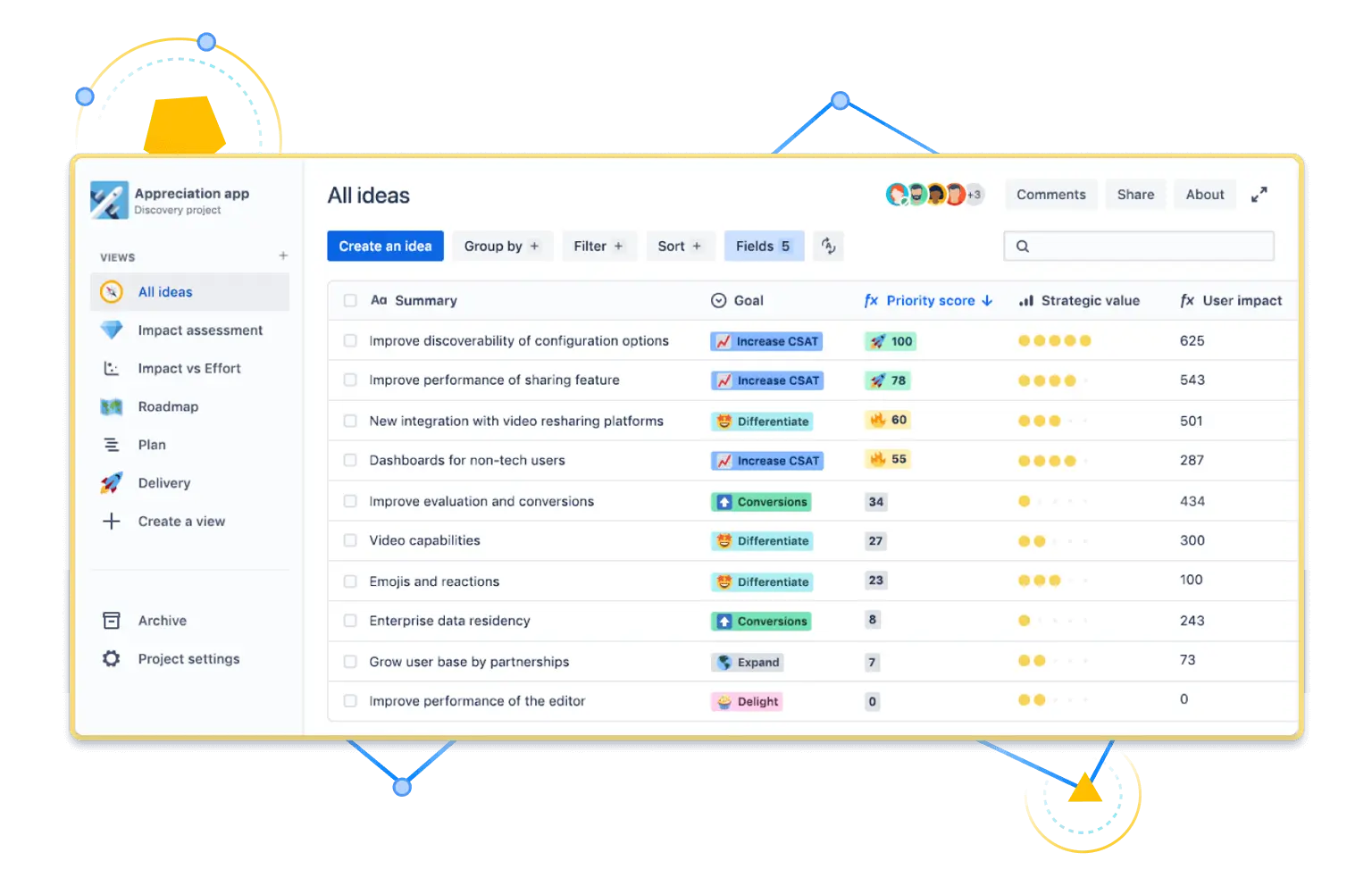
Jira Product Discovery is a tool designed to strengthen the product management process by supporting the discovery phases. Aimed at product teams that want to deeply understand their users' needs and prioritize features accordingly, it offers a collaborative space where teams can gather insights, experiment with ideas and make data-driven decisions.
User research methods
User research is about understanding how potential customers interact with your product, and pinpointing their needs and pain points.
It matters for two reasons. First, it lets you validate your product idea. Second, it helps you understand how to build a product that solves the problem the way users want.
User research tools
- Surveys and questionnaires: tools to quickly collect quantitative data from a large audience. They're useful for understanding demographics, preferences and user satisfaction.
- Interviews and focus groups: these tools allow direct contact with users and provide qualitative insight into their needs, motivations and attitudes. They're valuable for exploring complex behaviors and preferences in depth.
- Usability testing platforms: they let you test the usability of sites, apps and prototypes, observe how real users interact with a product and identify usability problems.
- Analytics tools: they track and analyze how users interact with a product or a site. They provide data on engagement, retention and conversion, and help spot trends in behavior.
- Heatmaps and session recordings: these tools show visually where users click, scroll and spend time on a page, which tells you about their navigation journeys and possible areas for improvement.
- A/B testing tools: by testing several versions of a feature or a page, they let you find out which variants perform best in terms of engagement and conversion.
- Customer feedback platforms: they collect user feedback in real time, so you can react quickly to their suggestions, complaints and compliments.
Careers in user research
- User researcher: a specialist in studies that produce insights about users. They design and run studies, analyze the data and present the findings to inform product strategies.
- UX researcher: focuses on the user experience and users' interactions with products. They rely on usability tests, interviews and surveys to identify pain points and areas for improvement.
- Market research analyst: analyzes market trends and consumer preferences to guide product positioning and marketing strategies. This role often involves competitive analysis, surveys and focus groups.
- Product manager with a user research focus: not a role exclusively dedicated to research, but product managers often run or oversee studies to inform features, priorities and the roadmap.
- Design researcher: works with design teams to bring research insights into the design process, to make products more intuitive and more engaging.
- Data analyst focused on user insights: analyzes user data from different tools to bring out patterns, trends and insights useful for product development and user experience.
- Accessibility specialist: makes sure products are accessible to everyone, including people with disabilities. They run accessibility audits and user tests to identify and remove barriers.
Don't forget your most important touchpoint: your product
User research usually goes through interviews, but with a solution like Screeb you can also tap your main point of contact with your users: your product. Screeb helps you understand how people use your product, which main user segments to focus on, why they behave that way and what you should build next.
In a user interview, you're trying to understand:
- which problem the user is trying to solve;
- how they solve that problem today;
- what they like and dislike about the current solution;
- what their current pain points are.
User interviews are important, but they're only one type of user research among others: there are also surveys, focus groups and usability tests.
Finally, note that product discovery and user research aren't mutually exclusive: they're often run together. While you're doing product discovery, you should also be doing user research. That's what lets you validate your product idea and understand how to build a product your users will love.