What's the most important thing in your life? For most people, the answer is pretty obvious: health. And if you have children, it's your children's health. Is there anything more essential than being healthy and knowing our children are too?
Yet what do we do as soon as we start feeling unwell? We go to Google to look up our symptoms.
This habit perfectly illustrates the importance of the Customer Effort Score (CES): people want to find answers to their questions on their own. They don't want to contact a company, especially if it means sending an email or making a call.
Nobody likes doing that. Worse, if your customers can't easily find the information they're looking for, having to contact you becomes one of the main causes of their dissatisfaction. And when customers have to put in too much effort to interact with you, they end up going elsewhere.
That doesn't mean they'll never need to contact you again. In some situations, talking to a person for reassurance, personalized advice, or to resolve a complex problem remains essential. But it should be a choice, not an obligation because they can't find another way on your site or app.
Why measuring customer effort with CES is crucial
Since the effort your customers perceive directly affects their loyalty, it's essential to measure it accurately. That's where the Customer Effort Score (CES) comes in.
What is the Customer Effort Score (CES)?
The Customer Effort Score is a metric that assesses the effort a customer has to put in to:
- Use your product or service.
- Find specific information.
- Resolve a problem.
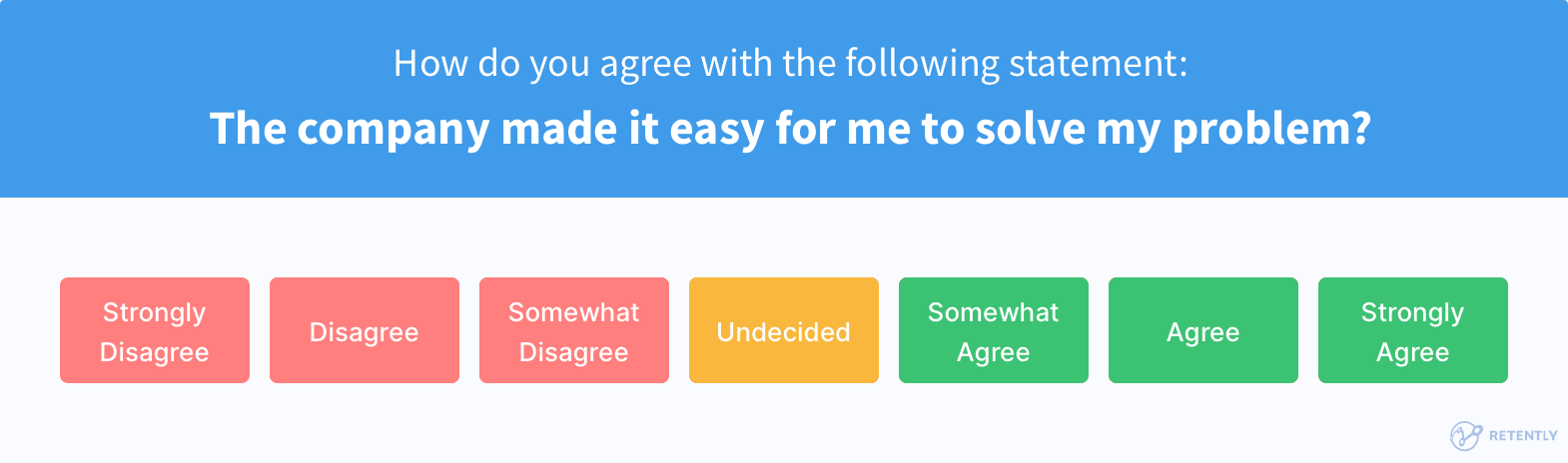
To measure it, you ask a simple question:
“[Your company name] made it easy to handle [specific task].”
Users rate their experience on a scale of 1 to 7, where 1 means “strongly disagree” and 7 means “strongly agree.”
CES, a key predictor of loyalty
In 2010, a study published in the Harvard Business Review covering more than 100,000 customers and 400 companies showed that the main reason customers disengage was too high a level of effort. This metric proved to be the most reliable predictor of customers' future behavior.
That's why closely tracking your CES should be a priority in your feedback and survey strategy.
Less effort, stronger loyalty
The lower the effort required, the better your CES and the more loyal your customers. In other words: to keep your customers, simplify their journey. They should be able to use your products and find what they're looking for without unnecessary obstacles.
Putting a Customer Effort Score strategy in place is therefore essential to improve the user experience, increase loyalty, and reduce churn. So if you want to retain your customers, keep things simple and intuitive.
How to measure your Customer Effort Score (CES) effectively
Understanding and accurately measuring the Customer Effort Score (CES) is essential to improving customer satisfaction and loyalty. This score assesses how easily your customers can resolve their problems, use your product, or access your services. Here's a simplified guide to measuring CES, with a particular focus on calculation and survey best practices.
How to calculate the Customer Effort Score
To calculate CES, simply ask customers to rate, on a scale of 1 (strongly disagree) to 7 (strongly agree), how easy the interaction was. For example: “[Your company name] made it easy for me.”
Formula for the average CES
- Add up all the scores you received.
- Divide the total by the number of responses.
This average score reflects the overall effort customers perceive when they interact with your product or service.
- A high score indicates customers find your services easy to use, which is the goal.
- A low score shows customers are running into difficulties, which may signal that some aspects of the user experience need improving.
By tracking how your CES evolves over time, you can detect trends, identify friction points, and measure the impact of your efforts to simplify the customer experience.
CES surveys: the key to collecting actionable feedback
CES surveys are the main tool for measuring this score. They let you capture immediate impressions of customer experiences.
When to send a CES survey?
- Right after an important interaction, such as a purchase or a support request.
- Immediately after critical events to get feedback while it's fresh.
Tips for creating effective CES surveys
- Keep them short and focused: surveys that are too long risk tiring respondents and skewing the results.
- Ask specific questions: focus on one precise interaction (for example, the experience during a purchase or a support request) to get actionable information.
- Use a clear response scale: whether it's numeric or descriptive, make sure it's easy to understand and consistent across all your surveys.
- Add open-ended questions: give respondents the chance to explain their rating and express their ideas or frustrations, to get deeper insights.
Measure your CES with customer feedback tools
Accurately measuring your Customer Effort Score (CES) is essential to understanding and improving your customers' experience. Customer feedback tools let you collect comments effectively at every touchpoint and analyze that data to get actionable insights. By building these tools directly into your products or services, you can automate sending CES surveys right after an interaction or a transaction. This ensures you get feedback while the experience is still fresh in your customers' minds, giving you accurate, relevant data.
The best customer feedback tools
To choose the most suitable feedback tools, you need to consider:
- Integration capabilities: the tool should integrate easily with your existing platforms.
- Ease of use: it should be simple to pick up, for both your team and your customers.
- Analytical power: it should provide in-depth analysis so you can make good use of your CES data.
When to measure CES
CES should be collected right after a specific interaction with your company. This makes sure the customer remembers precisely how much effort was required.
In Screeb, you can use the targeting engine for in-app surveys to trigger a CES survey automatically and make sure the question is asked at the right time.
The 3 best times to send a CES survey
1. After an interaction with customer service
Customers avoid contacting a company by phone or email. If they do, it's crucial to make sure the experience was smooth and satisfying. Sending a CES survey right after a customer service interaction lets you assess whether the problem was resolved quickly and effectively.
2. After a purchase
CES is an excellent indicator of loyalty. Asking customers to rate the effort they perceived right after a purchase can help you understand whether they're likely to buy again and identify what to improve in the purchase journey.
3. After a sign-up
If your customers have to sign up to use your services, measuring how easy sign-up and onboarding are can help you spot obstacles. Use this survey to ask what worked or didn't, and why they chose to sign up.
Comparing CES with CSAT and NPS
Although CES measures the perceived effort of interacting with your company, it's often worth comparing it with other metrics such as CSAT (Customer Satisfaction Score) or NPS (Net Promoter Score).
CSAT (Customer Satisfaction Score)
CSAT measures a customer's immediate satisfaction with a service or product. For example:
- “How would you rate your overall satisfaction?” Answers are usually given on a scale of 0 to 100% or with simple options like “Satisfied / Not satisfied.” CSAT tends to be positive in most cases, and a sudden drop in the score is often a good sign of a problem. However, CSAT is not as good at predicting loyalty as CES.
NPS (Net Promoter Score)
NPS assesses long-term loyalty by asking:
- “On a scale of 0 to 10, how likely are you to recommend our company?” The score is calculated by subtracting the percentage of detractors (scores of 0 to 6) from the percentage of promoters (scores of 9 to 10). NPS is useful for getting an overall view of satisfaction and loyalty, but it's less effective for assessing a specific interaction. That's why CES is an excellent complement to CSAT and NPS.
Understand and improve your CES
Calculating CES is simple:
- Add up all the scores you received.
- Divide the sum by the number of responses to get an average.
In Screeb, your CES is displayed right in your dashboard.
What to do with your CES?
- If your CES is good: Congratulations! Keep measuring regularly to make sure it stays at the same level.
- If your CES is low: Don't panic. Analyze the open-ended answers to identify what to improve. Implement the necessary fixes, then measure CES again to check the impact of your actions.
Conclusion
CES is a strategic metric that helps you better understand your customers' experience and identify friction points. By using it alongside other metrics like CSAT and NPS, you'll be able to offer a smoother experience, improve customer loyalty, and optimize your processes continuously.
To set up your CES surveys, discover Screeb's in-app surveys or book a demo.