In recent years, companies around the world have been swept up in a whirlwind of change called digital transformation. From Fortune 500 giants to young startups, organizations of every size have deeply restructured their operations and strategies to adapt to the digital age. And just as we're catching our breath, another major shift is looming on the horizon: the move to a product-centered culture. In this article, we look back at the journey of digital transformation and explore why the future now runs through product transformation.
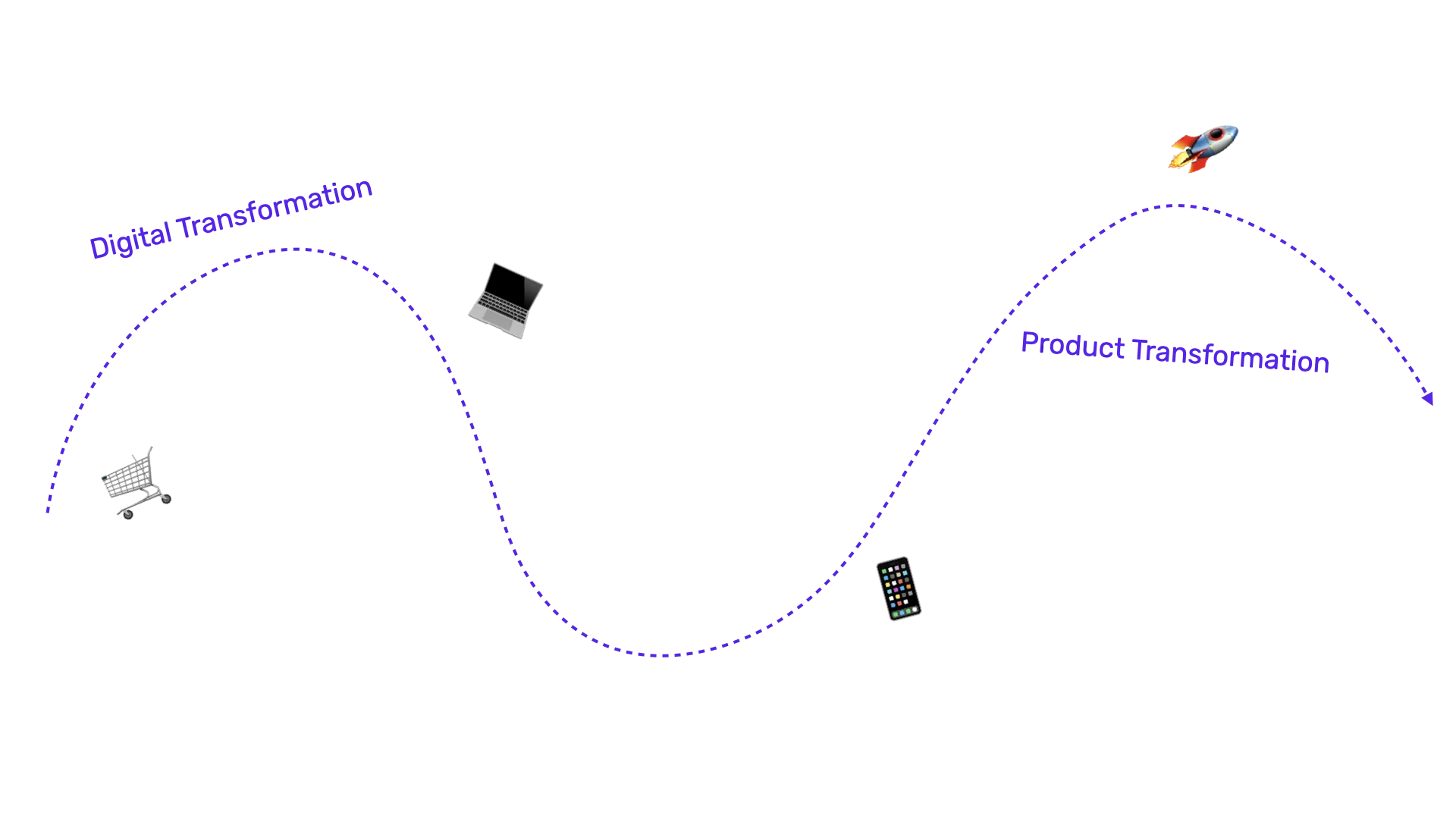
Digital transformation: one of the great shifts in economic history
Digital transformation was a landmark: it changed the business world forever. It was much more than a technology wave. It's an evolution that transformed the very fabric of companies, changing how they operate, compete and even survive. Let's go back and see how this revolution unfolded.
The dawn of the digital age
Digital transformation didn't appear overnight. It's the result of several technological advances that had been maturing since the late 20th century. The explosion of the internet in the 1990s and the arrival of Web 2.0 were major catalysts, paving the way for a new way of doing business. Then, with the arrival of smartphones and mobile apps in the early 21st century, customers began to interact with companies through new digital channels, setting the stage for digital transformation.
A paradigm shift for businesses
Faced with such upheaval, companies had a clear choice: adapt to the new digital landscape or risk obsolescence. Many organizations started by digitizing their existing processes: moving paper files to databases, replacing in-person meetings with video calls, shifting from traditional marketing to online marketing. But digital transformation demanded far more than these surface-level changes.
It required organizations to deeply rethink their business models, strategies and operations. For example, companies had to move from product-centered approaches to customer-centered ones, recognizing that power now belonged to digitally comfortable consumers who demanded personalized, on-demand experiences.
At the same time, companies had to rethink their value chains. Traditional linear value chains, where each stage of a product or service's lifecycle was handled one after another, gave way to digital value networks. In these networks, several stages can happen in parallel and be coordinated digitally, which increases efficiency and agility.
The impact on businesses
The impact of digital transformation on businesses has been profound. Those that embraced change saw substantial improvements in efficiency, customer engagement and agility. For example, by automating routine tasks, organizations freed up time for their people to focus on strategic initiatives. By leveraging digital channels, they could reach and engage their customers in a more personalized and interactive way. And by digitizing their operations, they could react faster and more effectively to market changes.
However, digital transformation also had its share of challenges. Cybersecurity became a major concern as companies moved their activities online. The need to train and reskill teams emerged as a critical issue, in the face of new demand for digital literacy. Data privacy also became an issue, as companies began collecting and analyzing customer data on an unprecedented scale.
What's more, digital transformation required a change in company culture. It took a culture of experimentation, where companies accept taking risks and learning from their failures. A culture of collaboration, where cross-functional teams work together to drive digital initiatives. And a culture of continuous learning, where organizations commit to staying ahead digitally.
Product transformation: the next step
As the dust of digital transformation settles, we find ourselves on the edge of a new major shift: product transformation. Now that every company has gone digital, attention is moving toward improving experiences. Let's look more closely at this emerging trend: what a product culture is, what a product organization looks like and why these elements are essential to success in the digital age.
Why: the dawn of the product era
In a world where digital technology has leveled the playing field, companies are discovering that having a digital presence is no longer a differentiator, but a minimum expectation. Since virtually every business has gone digital, customer expectations are soaring. Today's consumers don't just ask for digital access: they want intuitive interfaces, personalized experiences and value-added services.
That's where product transformation comes in. It's not simply about having a digital presence, but about maximizing the value of that presence through superior products and user experiences. In the digital age, your product isn't just an offering: it's a touchpoint in the customer journey, a representation of your brand and a driver of customer satisfaction and loyalty.
What: what a product culture looks like
So what does a product culture look like? At its core, a product culture is about putting the customer first. It's about understanding their needs, expectations and pain points, and building products that meet them. It's about seeing your product as a dynamic entity that evolves with customer feedback and market trends.
A product culture is also a spirit of innovation. It encourages people to experiment, take risks and learn from their failures. It values diversity of viewpoints, recognizing that the best ideas often come from different perspectives.
Finally, a product culture is about agility. It recognizes that in a fast-moving digital landscape, the ability to adapt quickly to market changes and customer feedback is the key to staying competitive.
How: building a product organization
Implementing a product culture requires transforming your organization into a product organization. But what does that transformation involve?
A product organization is structured around the product. Instead of organizing teams by function or by project, you organize them by product or product line. Each team, led by a product manager, is cross-functional and has all the resources it needs to build, market and support the product.
In a product organization, decisions are data-driven. Product managers and their teams regularly review product performance and user engagement metrics. These insights inform decisions on features, marketing strategies and customer support.
Product organizations also value collaboration and communication. Regular check-ins, like stand-ups and retrospectives, make sure all team members are aligned on the product's vision, priorities and progress. These practices also make it easier to share learnings and feedback, and encourage continuous improvement.
The impact: the promise of product transformation
By embracing product transformation, companies have a lot to gain. A product-centered approach can lead to better customer experiences, greater loyalty and increased market share. It lets you anticipate and shape market trends, rather than just react to them. In addition, by cultivating innovation and agility, companies ensure their survival and long-term success in a competitive digital environment.
The central role of product managers in product transformation
The role of the product manager (PM) has always been important in organizations. But as companies around the world commit to product transformation, PMs are moving from being important players to central figures who drive this change.
The catalysts for customer-centered products
Product managers are, in essence, the customer's advocates within the organization. They have a deep understanding of the customer's needs, behaviors and pain points. They draw on these insights to guide the development of products that are not only innovative, but also deeply aligned with what customers want.
In the era of product transformation, delivering customer-centered products is paramount. PMs, with their finger on the customer's pulse, are particularly well placed to keep development efforts constantly aligned with customer needs. The result is products that are not only functional, but also offer the user an enjoyable and meaningful experience.
The conductors of cross-functional teams
A product manager's role isn't limited to understanding the market and the customer. They also play a crucial role in aligning the different cross-functional teams (from engineering to marketing to sales) around the product vision.
In a product-centered organization, where teams are structured around products, the PM becomes the glue between these different functions. They communicate the product vision, make sure all team members work toward shared goals and manage dependencies between teams.
The navigators of business strategy
Another key responsibility of product managers is aligning product strategy with the company's overall strategy. When companies transform around the product, their strategic objectives can change significantly. It's up to the product manager to make sure the product roadmap reflects these shifting priorities.
PMs have to balance market demands, customer needs and the company's strategic goals. This strategic navigation, which takes a unique mix of market sense, customer empathy and business acumen, makes PMs an essential driving force in the product transformation journey.
The champions of a product mindset
Product managers also play a decisive role in developing a product mindset across the organization. They promote a culture of innovation, experimentation and customer focus, which are the essential elements of a product culture.
PMs lead by example: they take calculated risks, learn from their failures and stay resolutely focused on the customer. In doing so, they help anchor the values of a product culture in their teams and across the whole organization.
The data wranglers
In the product era, data is king. Product managers are responsible for defining and tracking the product's key metrics. They harness the power of data to understand product performance, user behavior and market trends.
These insights let PMs make informed decisions on features, prioritize the product backlog and identify opportunities for improvement or innovation. As companies advance in their product transformation, this data-driven approach becomes vital to success.
The challenges of product transformation
The shift from digital transformation to product transformation is both a necessity and an immense challenge. At a time when customer expectations are rising and competition is fierce, companies that don't adopt a product-centered approach risk losing their relevance. Yet the path of product transformation is strewn with obstacles. Here's an overview of the challenges ahead, and how solutions like Screeb can ease the transition.
Adopting a new mindset
One of the fundamental challenges of product transformation is the need for cultural change. Moving to a product-centered approach isn't about putting new practices in place or rolling out a new suite of tools. It's about adopting a new mindset: the product mindset.
Adopting this mindset means valuing the customer experience over mere functionality, seeing failure as an opportunity to learn and cultivating collaboration and innovation. This change isn't easy. It takes strong commitment at every level of the organization, especially from leadership, and a willingness to challenge the status quo.
Rethinking organizational structures
Another major challenge is reorganizing teams around products. It's a radical break from the function- or project-based structures most companies are used to.
Creating product-centered teams takes careful planning and execution. Roles and responsibilities have to be redefined, new processes put in place and people trained to operate effectively in this new framework. The transition can be disruptive and cause confusion and resistance at first.
Building product expertise
Moving to a product-centered approach also requires building product expertise in the organization: hiring and training product managers, forming cross-functional product teams and developing product management skills.
But finding experienced product managers and upskilling existing employees to take on product roles can be difficult and time-consuming. Moreover, giving these people the right tools and knowledge to excel in their role is an ongoing process that requires significant investment.
Using data effectively
In the product era, data is essential to decision-making. Yet collecting, analyzing and drawing actionable insights from data is a complex task.
Organizations often struggle with data silos, where information stays locked in different departments or systems. They also have trouble determining the right metrics to track, analyzing data accurately and making data-driven decisions quickly and confidently.
Succeeding at product transformation with Screeb
Taking on these challenges can seem daunting, but solutions like Screeb make the path considerably simpler. Screeb is a user research and feedback management platform, designed to help companies become more product-centered.
Screeb gives product managers the tools they need to understand their users better. It lets them collect, analyze and act on user feedback, to make data-driven decisions and deliver products that truly resonate with them.
Screeb also makes collaboration easier within and across product teams. It offers a single platform where team members share insights, discuss ideas and align on priorities. This fosters more coordinated, more effective product management.
Finally, Screeb encourages a culture of continuous improvement and learning. It lets teams track product performance, learn from user feedback and iterate quickly on their products. This feeds a culture of experimentation and learning, a cornerstone of the product mindset.
Conclusion
At the crossroads of the digital era and the product era, one thing is clear: embracing product transformation isn't a choice, but a necessity for companies that want to thrive in the digital age. The path may seem daunting, dotted with challenges, and may require fundamental changes in mindset, structure and expertise. But every challenge comes with an equal opportunity.
Product transformation offers the chance to revitalize how your organization serves its customers, foster innovation and create a competitive advantage. It represents the shift to products that are not only functionally robust, but also able to deliver truly enjoyable, personalized experiences to their users. It's a chance to innovate faster, adapt more easily to market changes and keep pace with rising customer expectations.
What's more, you don't have to set out on this transformation journey alone. Solutions like Screeb exist to give you the tools, insights and support you need to meet the challenges and seize the opportunities of this new product era.
The product era marks the next leap in the evolution of businesses. It's about going beyond simply "doing digital" to truly being digital. It's about putting the customer at the heart of your strategy and creating value at every touchpoint.
It's an exciting time, a time of change and immense opportunity. The companies that come out ahead in this new era won't be those that fear change, but those that embrace it. They'll be the organizations that dare to redefine their culture, rethink their structures and reinvent their offerings. They'll be the ones that see the challenges of product transformation not as obstacles, but as steps toward greater success.
So as we enter this new era, let's not hold back. Let's embrace product transformation with open arms and an open mind. Let's seize the opportunities it offers to make our organizations more customer-centered, more innovative and more resilient. After all, a journey of a thousand miles begins with a single step. And that first step is embracing product transformation.