

At Doctolib, the Global Patient team went from manual, partial feedback collection to a structured Voice of Customer program across 3 countries (France, Germany, Italy). With Screeb, local teams have more autonomy in creating surveys and product tours, while the Global Patient team keeps the brand consistent. The result: a roadmap continuously driven by real feedback, and 20 times more App Store and Trustpilot reviews.
At Doctolib, measuring the patient experience is about more than a satisfaction score at the end of the journey. Behind every piece of feedback is an emotionally charged relationship with health: people don't come to a medical app the way they come to any other product, but with expectations that sometimes touch on fears, stress and personal stakes.
“In healthcare, you're not just looking for an app that works well: you're dealing with fears and stress. That's why measuring satisfaction goes beyond other industries.”
— Naima Zakaria, Patient Go-To-Market Manager, Doctolib
This is the challenge Doctolib took on by rethinking, from the ground up, how it collects and uses patient feedback across its three markets: France, Germany and Italy.
The real problem: partial, manual patient feedback
For a long time, patient feedback collection at Doctolib relied on a largely manual setup.
“We had a homemade method: we ran all our surveys by hand, and every time we depended on a technical roadmap to launch them.”
— Maud Laisney, Product Manager, Doctolib
In practice, no business team could launch a survey on its own initiative to test a hypothesis or check a user's perception: it first had to get a slot on an already busy technical roadmap.
This constraint had a more insidious side effect than simply slowing things down: it reduced the feedback setup to its lowest common denominator, an NPS triggered only at the very end of the online appointment booking funnel. A choice that, by design, only captured patients whose journey had gone well. Patients who had a harder experience, often the most instructive for prioritizing product improvements, remained largely invisible.
“We only captured positive feedback, at the end of the booking journey. Our feedback was biased and we lacked perspective on the full experience.”
— Maud Laisney, Product Manager, Doctolib
So the real problem to solve wasn't just tooling: it was giving autonomy back to every team that needs patient feedback day to day, without losing brand and communication consistency across the whole product.
A structured rollout across 3 countries
At Doctolib, the use of Screeb quickly grew well beyond the classic satisfaction survey. Today it covers three complementary uses:
- recurring surveys, which measure overall and per-feature satisfaction to continuously feed the product roadmap;
- ad hoc surveys, used for user research and design tests;
- in-app messages, more recently, which highlight certain features directly in the app.
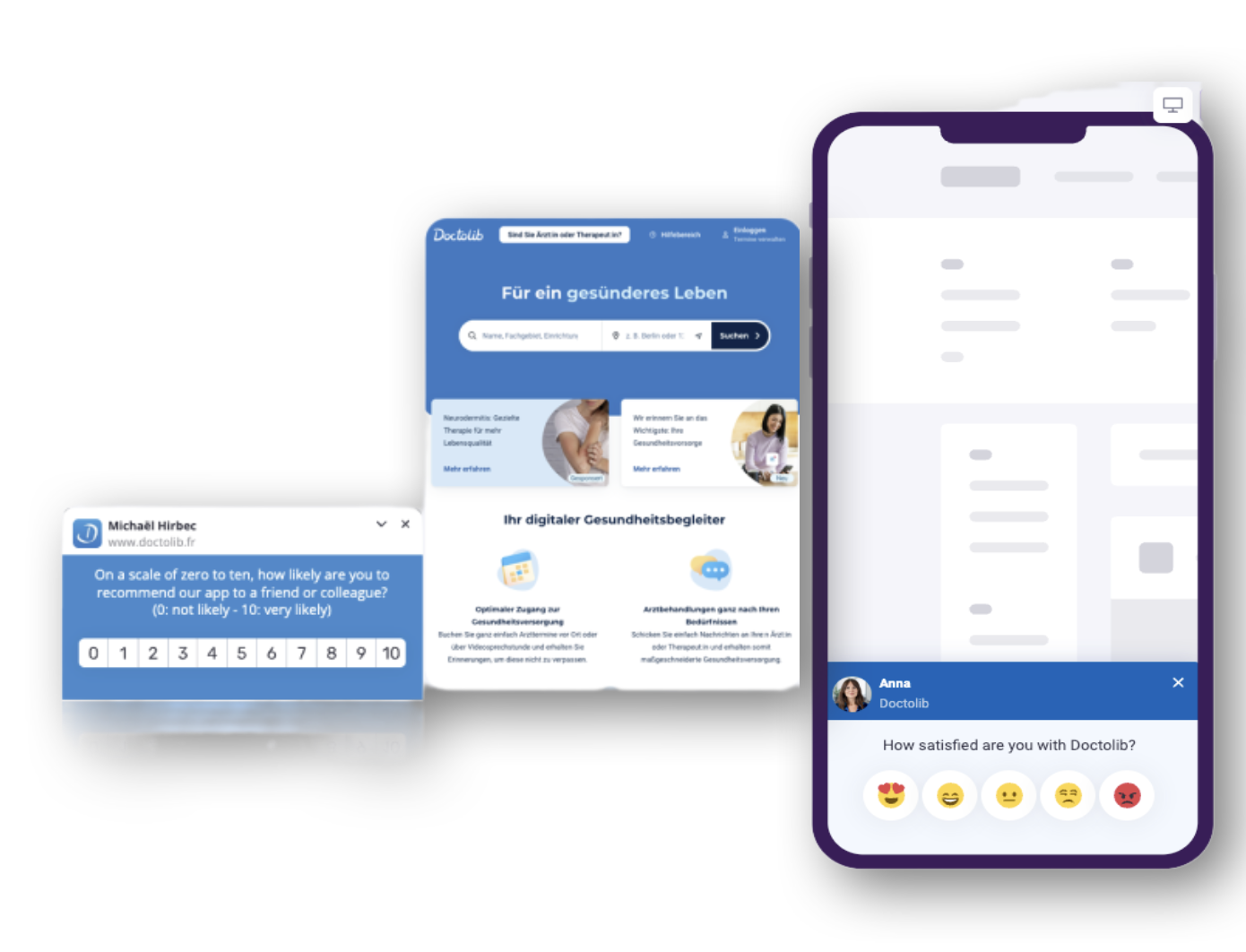
This variety of uses called for an organization to match. Doctolib structured its Screeb workspaces by country (France, Germany, Italy), each with its own separate production and test environments. In practice, local teams design, test and iterate on their surveys on their own test workspace; the Global Patient team then takes over for the production rollout, making sure the survey follows the brand's communication guidelines.
Franziska Maria Bauschert, Product Marketing Manager, sums up this balance well: teams stay “fully autonomous in creating, testing and iterating on their surveys,” while her team keeps control of the overall “coordination and consistency.”
This autonomy has made the tool a reflex for a growing number of teams, well beyond the Global Patient team that first championed it: the Prevention team, the B2C teams in each country, and the Product and Design teams for user research and design tests.
The concrete results
Beyond internal adoption, Screeb's impact at Doctolib shows up most concretely in three areas: the ability to evolve a product based on real feedback, patient engagement beyond mere measurement, and the brand's external visibility.
The health tab, rewritten with patients
The most telling case is probably the launch of the health tab. Even before talking about post-launch feedback, Screeb was first used to recruit the first test users to co-build the feature with them. Once the tab launched, the feedback collected through Screeb showed that many patients found the vocabulary too technical, too medical, not accessible enough: a signal Doctolib probably wouldn't have picked up with a generic end-of-funnel NPS. The team was able to rewrite the feature's wording accordingly.
“Patients told us that some of the words in the Health tab were too technical, too medical. With Screeb, we rewrote the wording so it really speaks to them.”
— Naima Zakaria, Patient Go-To-Market Manager, Doctolib
Product tours to guide usage
Product tours, for their part, let Doctolib go beyond simple measurement and actively guide usage. Several cases were tested internally: a support message when an account is created, an onboarding product tour after signing up in the mobile app, and, more recently with the SEO team, a targeted invitation to add Doctolib as a preferred source on Google.
Public reviews multiplied by 20
External visibility is where the impact shows most clearly. The monthly flow of feedback across all features now lets Doctolib adjust its product roadmap continuously. But Screeb has also been used to guide patients outward: prompting them, at the right moment, to leave a review on the App Store or Trustpilot. The result exceeded the team's expectations:
“Screeb let us multiply patient feedback and the number of reviews on the App Store and Trustpilot by 20.”
— Naima Zakaria, Patient Go-To-Market Manager, Doctolib
Finally, the expansion into the Italian market shows how Doctolib adapted its use of Screeb to contexts very different from its historical French market, using the tool both to better understand Italian patients' expectations and to engage users already on the platform.
More autonomy for teams, a long-term collaboration
Two things tipped the balance in favor of Screeb. First, the tool's UX and ease of use: a decisive criterion once the goal was to make non-technical teams autonomous in creating surveys, not just data or product experts. Second, a tool-consolidation logic that paid off over time: at that point, Doctolib was supplementing its survey solution with a third-party tool dedicated to translating, automating and categorizing customer feedback. That tool has since been dropped, as Screeb built these features directly into its product suite.
Since then, the relationship between the two teams has played out on two levels: day-to-day operational follow-up, with support that Doctolib finds very responsive for everyday questions; and a more strategic weekly ritual, in which Doctolib presents its vision, its roadmap and the major initiatives of the half-year to the Screeb teams. This is where the two teams co-build how the tool can support the specific challenges of each market.
What's next: moving from reactive to proactive
Even today, Screeb is mostly used reactively at Doctolib. Naima Zakaria sees a natural evolution of this usage in the coming months, toward a roadmap dedicated to Screeb, with regular, planned promotion of certain features or use cases.
“We went from a reactive to a proactive use of Screeb.”
— Naima Zakaria, Patient Go-To-Market Manager, Doctolib
For Maud Laisney, this change shows up very concretely in her day-to-day: she now spends less time waiting for a slot to open up on the tech roadmap to launch a survey, and more time asking herself where and how to go get useful feedback.
Frequently asked questions
Why isn't an end-of-journey NPS enough to measure the patient experience?
Because it mostly captures users whose experience went well. Feedback from patients whose journey was harder, often the most useful for prioritizing product improvements, is largely underrepresented.
How does Doctolib organize Screeb across 3 different countries?
With separate workspaces per country (France, Germany, Italy), each with a production environment and a test environment. Each local team is autonomous, and coordination stays centralized with the Global Patient team.
What exactly is a Screeb product tour?
A message or guided sequence displayed directly in the product to support the user: for example a support message when an account is created, an onboarding after sign-up, or an invitation to complete a specific action.
What measured impact did it have on Doctolib's public reviews?
The volume of reviews and comments collected on the App Store and Trustpilot has been multiplied by 20 since Screeb was adopted.
Is Screeb suitable for a sector as regulated as healthcare?
Yes, and Doctolib has been proof of that for more than three years. Screeb hosts 100% of its data in France (with Scaleway and OVHcloud) and relies on French AI from Mistral AI: no data falls under extraterritorial law such as the US CLOUD Act. The details are on the data security page.
Conclusion
By moving from a makeshift, centralized survey setup to an autonomous patient feedback program organized by country, Doctolib brought the voice of the patient into user research, product and marketing all at once. The result: a roadmap continuously driven by real feedback, and a volume of public reviews multiplied by 20.