

The starting point came from the field: in interviews, recruiters were asking for features… that already existed. So the real challenge wasn't adding more, but making them visible and supporting their use. This article traces Hellowork's approach, initial findings, concrete cases (candidate filters, salary display, ATS rebranding) and measured results, to turn onboarding and feedback into levers for adoption, education and innovation.
The context
At Hellowork, the ATS (Applicant Tracking System, or application tracking software) was long designed as a functional, easy-to-pick-up tool, built for one clear goal: letting recruiters manage their applications and publish their job postings on Hellowork.com and other recruiting platforms. Users are autonomous from their first uses, but without dedicated guidance (product tours), some of them don't take full advantage of features that are in fact key. The existing onboarding quickly showed its limits:
- onboarding that was barely personalized and hard to update;
- an email sequence reserved for only some of the users;
- no contextualization based on the actions taken in the product.
Yet the user profile is far from homogeneous: experienced recruiters on one side, executives, managers and operational staff on the other.
“A lot of our users aren't professional recruiters. They recruit on top of their main role.”
The solution
The first finding came from the field: in user interviews, recruiters were asking for features… that already existed. The problem wasn't a lack of features, but a lack of visibility and guidance. Rather than building new features that sometimes duplicated existing ones, Hellowork chose to help users make better use of what already existed and, through Screeb, activates these levers without involving developers, freeing up their time for other product projects.
“I'd hear requests, I'd look at the screen, and I'd realize the feature was right there.”
A telling example: candidate filters, which many people redid manually every session without ever saving them. Rather than a generic email, Hellowork acts in the exact context of the problem through a targeted in-app message:
- an event defined on the “Save a filter” click
- a segment isolating users who filter without ever saving
- an in-app message triggered only for them, without bothering the others.
Screeb thus becomes an activation and testing toolbox: validate an idea with users before investing development time in it, then adjust the roadmap accordingly.
The results
Hellowork didn't stop at usage metrics. The team measured perceived hedonic quality (enjoyment of and buy-in to the product) among 478 respondents. Result: +57% among users onboarded via Screeb, who say they enjoy using the ATS more and identify with it more easily.
As for onboarding product tours, the best performers are those that provide landmarks from the very first steps:
- Welcome message: 25%
- Workflow presentation: 28%
- Resume database presentation: 22%
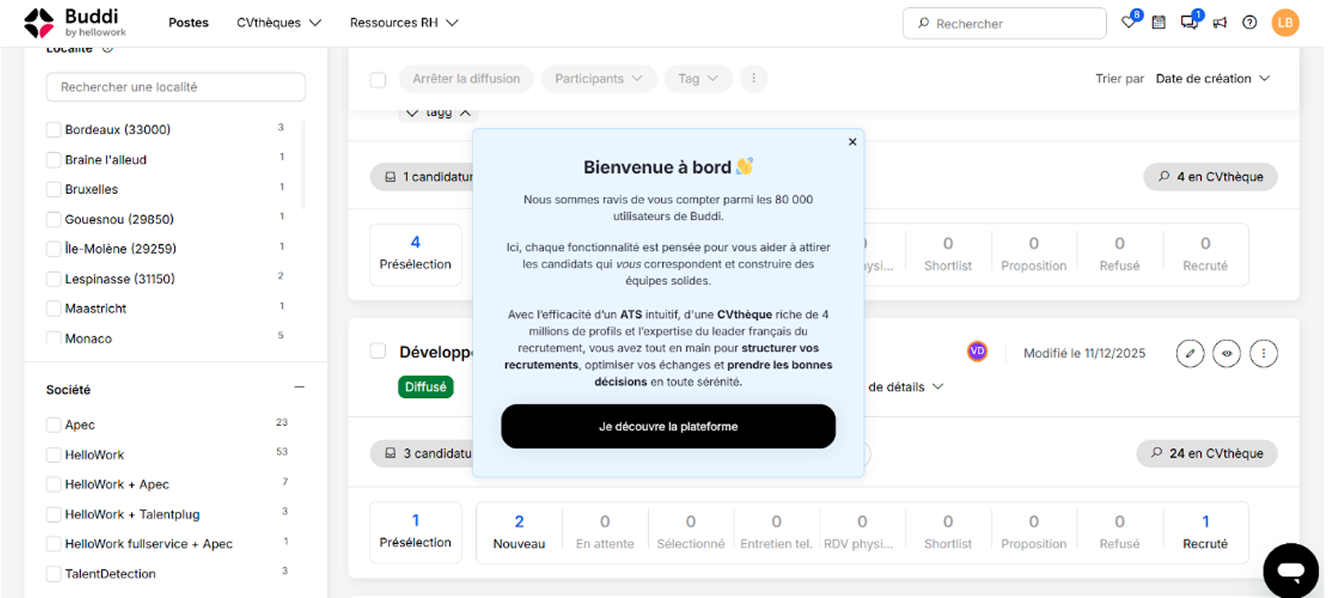
During the rebranding of the ATS (now Buddi), in-app became the number 1 product communication channel:
- 7,100 views and an average visit of 1 min 29 s on the dedicated landing page;
- 71% of traffic generated by in-app, versus 6% for email and 23% for other sources;
- ~90 s of average engagement, well above the performance of traditional email.
In detail, the performance observed varies by in-app format:
- Contextual modal: ~9% interaction
- Banner: ~3%
- Main onboarding: ~25%
From product feedback to recruiter education
Also deployed on the candidate platform, Screeb makes it possible to relay candidates' real expectations to recruiters. These insights feed training modules, webinars and educational content; feedback becomes a decision-making aid, but also a way to evangelize the profession.
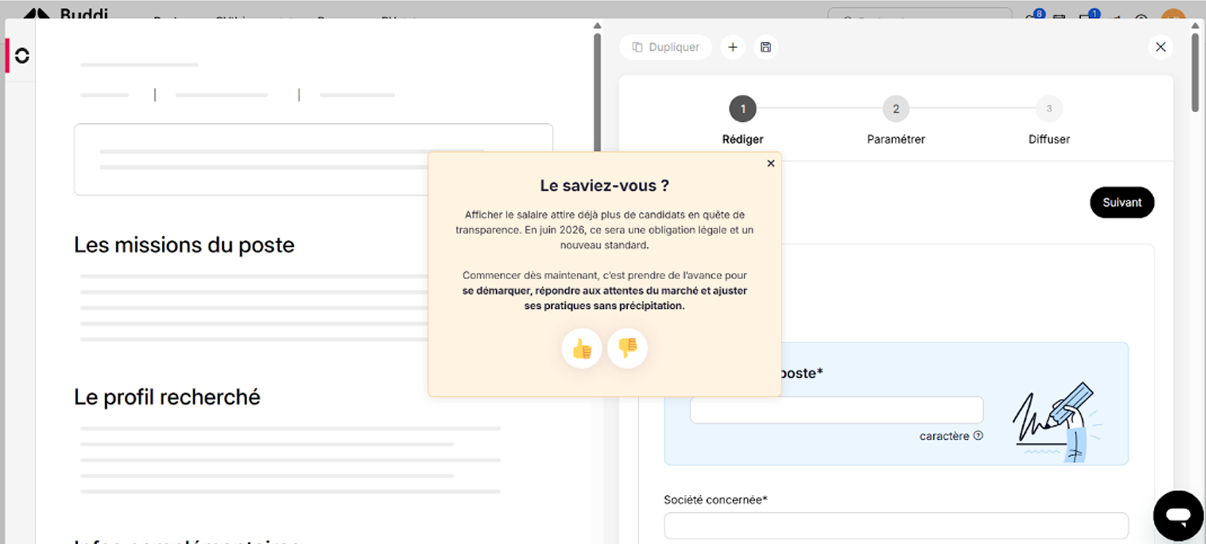
The salary display case illustrates this: candidates expect it and French legislation will progressively require it, yet recruiters often keep it hidden. Rather than blocking the action, an in-app message triggers after the behavior repeats, to remind recruiters of candidates' expectations and explain the concrete benefits.
“At that point, we're no longer just in the tool, we're doing consulting.”
Key takeaways
- Adoption can't be decreed, it has to be contextualized.
- Feedback isn't only for prioritizing a roadmap: it also feeds education and communication.
- Onboarding can become a lever for education and innovation, not just activation.
- In-app far outperforms email in real engagement.
Conclusion
Without transforming its organization or complicating its product, Hellowork improved adoption, strengthened perceived value and made feedback a cross-functional asset. Concrete proof that the product experience can become a strategic lever in its own right.