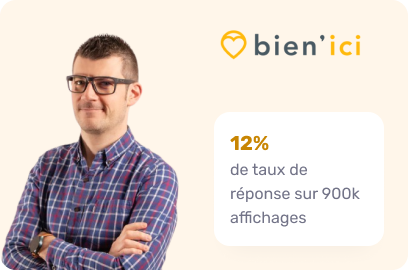
When Nicolas Oisel, Chief Product Officer, took over product leadership, he identified a major need: putting in place a more structured, continuous discovery approach, open to the whole team, without depending on developers or heavy processes. That is the context in which Screeb was introduced, to transform Bien’ici's product culture through better-integrated, faster and more strategic user feedback.
The context
Before Screeb:
- no continuous feedback channel on the B2C side;
- a very well-structured product team, but forced to make decisions based on weak signals;
- tools tested without enough ROI (AB Tasty, Hotjar).
“We had a very precise view of what users were doing. But no idea why they were doing it, or why they weren't.”
The challenge
- Quantitative data, but no user insights. The team could see what users did on the site, but not why they did it (or stopped). There was no structured channel for collecting qualitative data.
- Difficulty arbitrating product decisions. Without reliable user feedback, roadmap choices relied on internal hunches, sometimes disconnected from real usage.
- Weakly structured discovery. The tools previously tested (AB Tasty, Hotjar) were too marketing-oriented or poorly suited to Bien’ici's unique interface.
The solution
- Rolling out Screeb. Setting up ultra-targeted surveys at the heart of user journeys, without involving the tech team.
- Fast adoption by PMs. Screeb became a go-to tool, used both to test ideas and to investigate a problem after launch.
- A clear methodology. Every survey is tied to a product decision. Questions are reviewed, tested and acted on quickly.
The results
- Time savings: decisions are made within 48 hours thanks to contextual feedback.
- Better product-tech alignment: fewer debates over opinions, more decisions based on evidence.
- Stronger team engagement: developers take part in forming hypotheses and better understand product priorities.
What Screeb changed at Bien’ici
- A reflex in every product cycle: from ideation to post-launch, every step includes structured user feedback.
- A variety of use cases: concept testing, friction detection, prioritization, impact measurement, and more.
- Tangible results: a high completion rate (up to 40%), decisions made faster, and a better shared understanding of user issues.