
HiPay is a major player in Europe in digital payment solutions, known for making online transactions smoother and safer. As a key fintech player, HiPay is known for offering advanced payment services to a wide range of businesses, from growing startups to large enterprises. At the heart of HiPay's approach is a commitment to improving the user experience, constantly updating its technology to meet the changing needs of the digital economy.
The challenge
To improve its product's UX, HiPay decided to redesign its back office. This product UX redesign strategy includes two main objectives:
- Launching a New Back Office: Put in place a new, user-friendly back-office interface.
- UX Redesign: Develop a new UX to meet customers' evolving needs.

The solution
A UX strategy centered on users
To overcome the two main challenges HiPay identified, launching a new user-friendly back office and redesigning the UX to meet its customers' evolving needs, a well-defined UX strategy is essential:
- Put in place a user-centered UX strategy for a high-performing back office Creating a new back-office interface must rely on a deep understanding of end users' expectations. An effective UX strategy includes feedback collection tools to gather insights in real time, as well as co-creation workshops to involve users in the process. Prototyping and user testing phases make it possible to iterate quickly on features and make sure the interface is intuitive, user-friendly and aligned with customers' operational needs.
- Adopt a scalable UX strategy to anticipate and meet customer needs Faced with constantly evolving expectations, HiPay must build into its UX strategy mechanisms to continuously analyze user behavior and feedback. Flexibility becomes a central pillar: by designing a modular UX, HiPay can iterate quickly and adjust its priorities based on emerging trends. A continuous feedback loop, combined with relevant UX KPIs, makes it possible to measure the impact of improvements and ensure lasting user satisfaction.
By relying on a clear UX strategy centered on users' real needs, HiPay can turn these challenges into opportunities for innovation, while strengthening customer engagement and loyalty. This approach ensures that every decision made during the product redesign is based on tangible data and reliable user insights.
UX strategy and user feedback collection
HiPay quickly understood that a solid UX strategy rests on a deep understanding of users. To do that, it was essential to put in place a tool dedicated to collecting user feedback, able to meet specific needs. This tool had to not only allow precise segmentation of their audience, but also engage users at the most relevant moments of their journey.
The goal? Maximize response rates and turn feedback into actionable insights.
Thanks to this approach, HiPay was able to take on several key challenges:
- Collect a significant volume of user feedback to ensure a complete, representative view.
- Segment feedback by user profile and usage context, to better target problem areas.
- Automatically centralize feedback in a single tool, making it easier to access and manage.
- Analyze the data collected to identify specific needs and friction points to resolve.
- Reach end users, who are often different from decision-makers or buyers, to make sure the product meets their real expectations.
- Build a truly user-centered product, placing their needs and behaviors at the heart of every decision.
This proactive approach let HiPay refine its UX strategy based on concrete data, strengthening the relevance and impact of its product improvements.
How do you choose the best user feedback tool for a product redesign?
HiPay found in Screeb much more than a simple tool, but a genuine strategic lever for its UX redesign. Thanks to its flexible platform and advanced user feedback collection capabilities, Screeb helped HiPay better understand its users' behaviors, expectations and friction points. This level of detail, both qualitative and quantitative, served as the foundation for informed decisions, turning challenges into opportunities to optimize the user experience of its products.
The results
Screeb: a catalyst for HiPay's UX strategy. The level of detail obtained, both qualitative and quantitative, served as the foundation for informed decisions, turning challenges into opportunities to optimize the user experience.
Strategic impact: a data-driven decision
By integrating Screeb into their product UX strategy, HiPay gained access to precise data on how users interact with their systems. This information made it possible to clearly identify what worked and what needed improvement. The approach based on user feedback provided a 360° view of customer expectations, strengthening the relevance of strategic priorities.
Thanks to this methodical framework, every product update was guided by concrete insights, making the interface more intuitive, high-performing and aligned with market needs. This ability to adapt was crucial to keeping HiPay competitive in the digital payments industry, where user experience is a key differentiator.
Operational impact: better prioritization and efficiency
Screeb's tools let HiPay turn raw feedback into concrete operational actions. Detailed feedback helped prioritize development, focusing effort on features that had a real impact for users. As a result, HiPay's teams were able to adopt a user-centered approach, turning insights into measurable improvements. This made it possible to deliver a more refined, intuitive and high-performing product while making the most of internal resources. The efficiency gained translated into a significantly improved user experience and a stronger position in a highly competitive market.
Financial impact: a profitable investment
By using Screeb to structure its UX strategy, HiPay optimized its investments by avoiding unnecessary spending on poorly targeted features. Feedback analysis made it possible to concentrate effort and budget on tangible improvements, directly tied to user needs.
Result:
- Happier customers.
- Increased engagement.
- Stronger retention.
These gains in customer satisfaction also had positive financial effects, because an optimized user experience naturally drives better retention and higher conversion rates. HiPay thus showed that putting user feedback at the center of its UX strategy is an approach that is not only smart, but also sustainable from an economic standpoint.
The teams using Screeb at HiPay
At HiPay, the rollout of Screeb was first driven by product managers and designers, two key teams in developing and improving products. Product managers used Screeb to identify functional improvements based on user feedback, while designers focused on optimizing the interface and user journeys using the insights collected.
Given the results, HiPay extended its use of Screeb to the product marketing team. This new adoption let marketing adjust its strategies more precisely, relying on real, contextualized data that reflects user preferences and behaviors. This cross-team collaboration shows how a well-integrated tool can become a cross-functional lever to maximize the impact of each function.
Conclusion
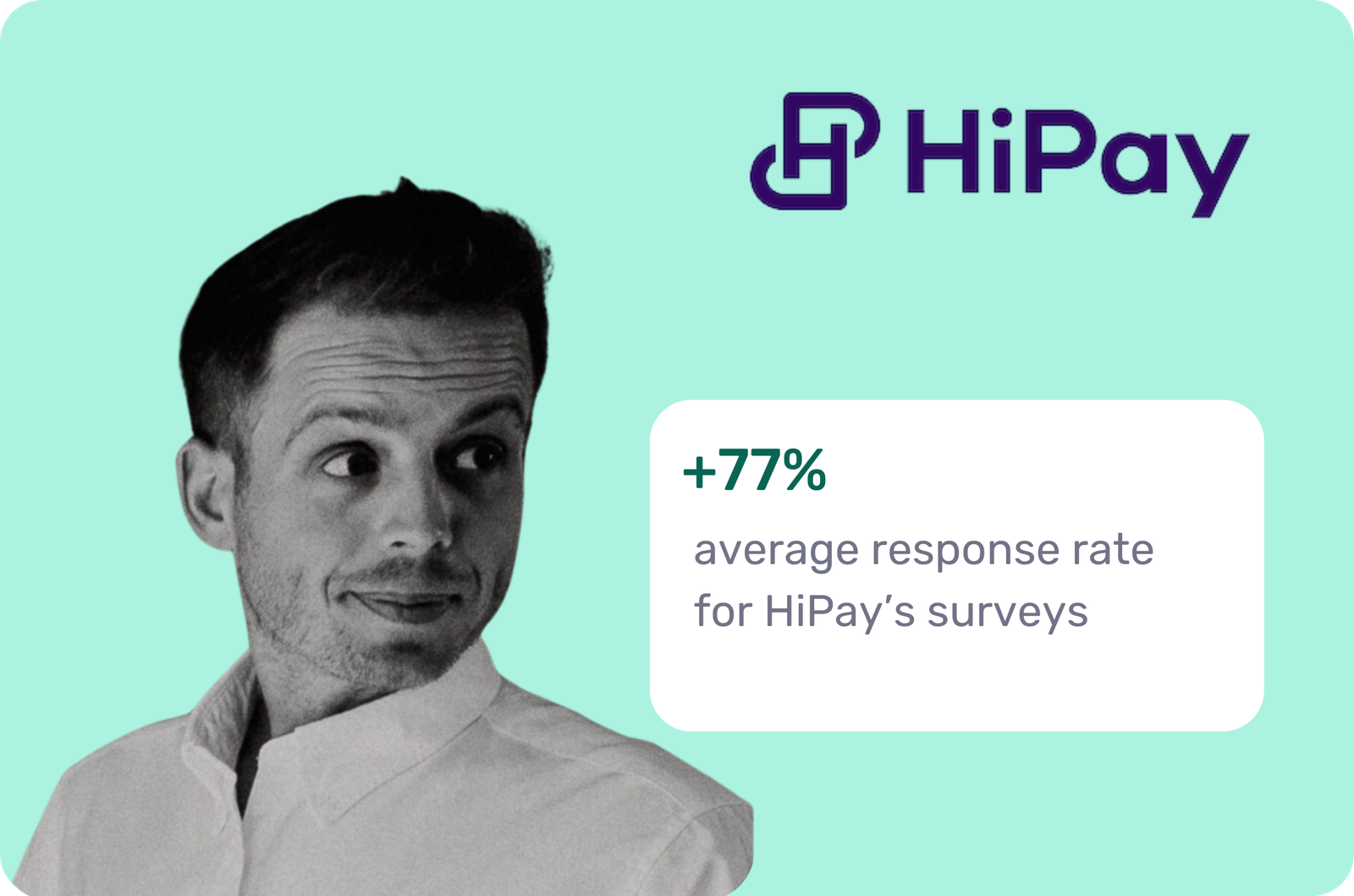
The collaboration between HiPay and Screeb has turned its product UX strategy into a genuine engine of continuous improvement. The results speak for themselves: an impressive 77% response rate and more than 1,500 weekly active users engaged in feedback collection. These figures reflect deep user knowledge and an informed decision-making process, allowing HiPay to innovate and meet its customers' evolving expectations.
Screeb is not just a tool, it's a strategic partner for any company looking to stand out in a user-centered digital environment. By offering solutions suited to the needs of product, design, marketing teams and more, Screeb positions itself as a catalyst for turning user data into concrete action. For organizations ready to put user experience at the heart of their development, Screeb is an essential choice.