
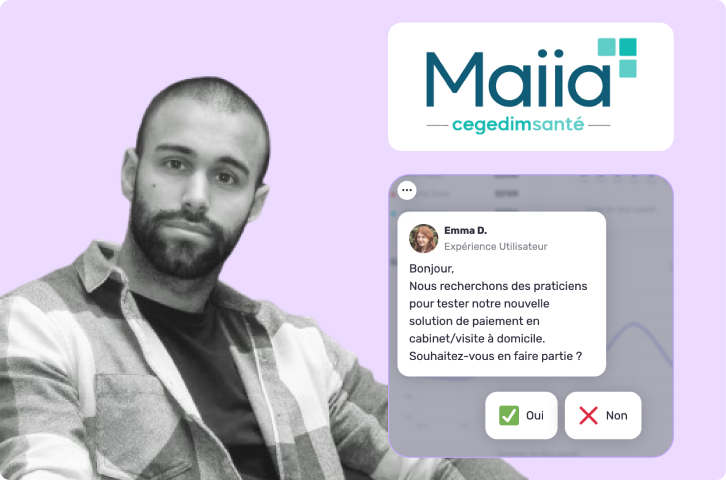
At Cegedim Santé, a recognized player in medical software, Alexandre Dandler, UX/UI lead, faced major challenges while restructuring feedback collection for their main product, Maiia. This case study explores the problems and impacts of ineffective feedback collection on a product like Maiia. It also details how Alexandre and his team transformed their approach to collecting feedback, placing data at the heart of product decisions. This new method now allows a better understanding of the needs of users, both professionals and individuals, and helps better prioritize the product roadmap.
Summary of Maiia's user feedback strategy
Problems encountered at Maiia:
- Difficulty measuring results: It was hard to analyze feedback objectively because of biases introduced by the sales team's anecdotal evidence.
- Ineffective feedback collection: The initial reliance on emails for collecting feedback failed to engage users effectively, most of whom use the app.
- Insufficient feedback volume: The company's emphasis on intensive qualitative feedback methods prevented scalable collection of broad insights.
Solutions implemented:
- Adopting Screeb: This switch to an in-app customer feedback platform considerably improved the quantity and quality of the feedback collected.
- Integrated feedback loop strategy: By using Screeb for in-app surveys and precise data segmentation, the team enabled informed, data-driven decisions.
Notable impacts:
- Support for product decisions: The new tools made it possible to gather fast, accurate feedback, effectively guiding development choices.
- Product roadmap optimization: By leveraging detailed user feedback, the team was able to prioritize development effort more strategically, ensuring the most critical user needs were met.
The context
Cegedim Santé, a leader in medical software for more than two decades, offers innovative digital solutions for healthcare professionals and their patients, with Maiia as its flagship product. Alexandre Dandler, who holds the role of UX/UI lead, is responsible for optimizing this platform to make it easier to use and improve the experience for both professionals and individuals.
With the support of a team of twelve people, Alexandre has put in place:
- Processes to improve collaboration between the product and development teams;
- UX tools designed to capture users' needs more precisely;
Before Alexandre's arrival, Cegedim Santé already understood the importance of collecting user feedback to refine its understanding of their needs and, in turn, build and prioritize a product roadmap aligned with Maiia's growth.
However, Alexandre quickly identified several major challenges with the existing feedback collection system:
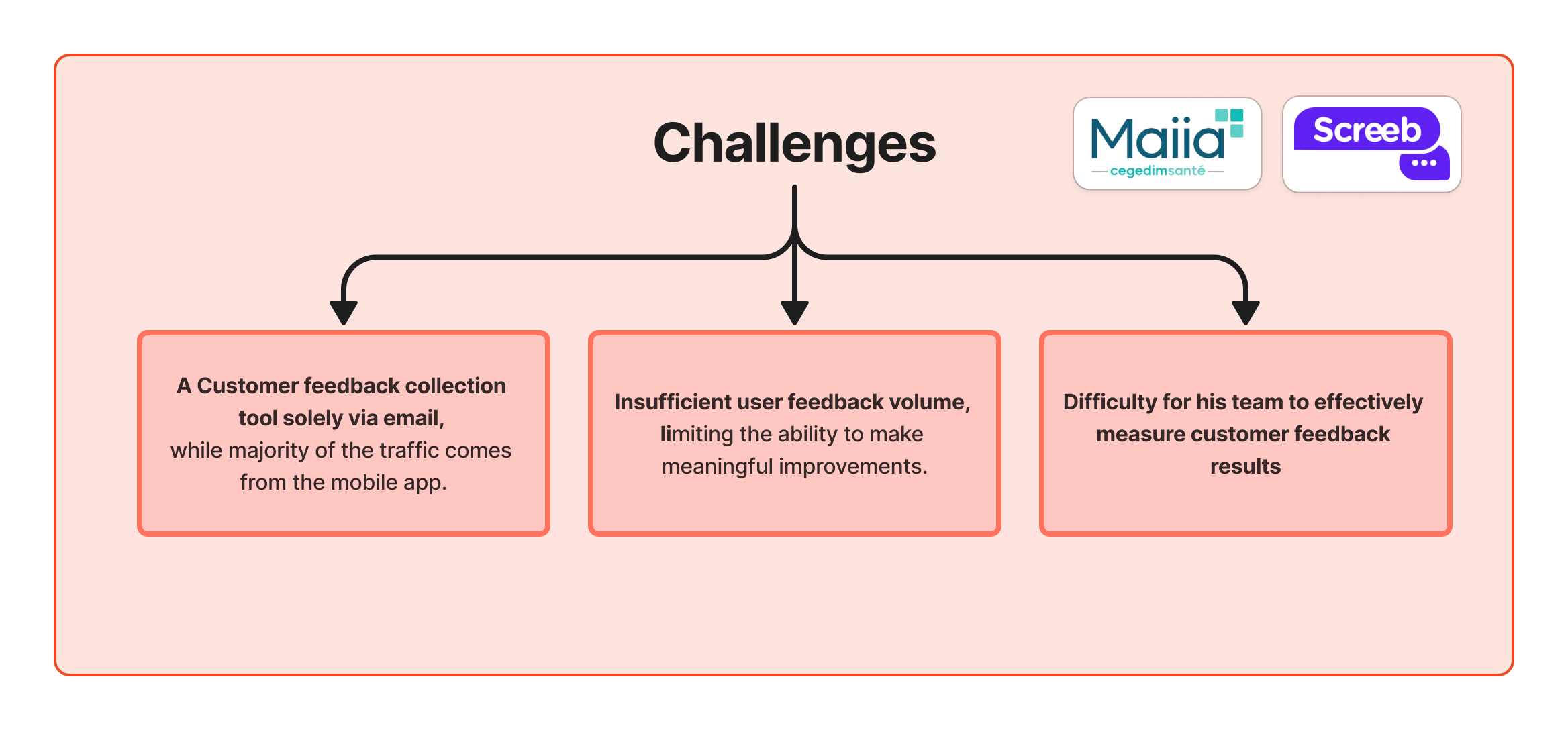
- A feedback collection system that relied exclusively on email, even though most of the traffic comes through the app.
- An insufficient volume of user feedback, limiting the ability to make meaningful improvements.
- Difficulty for him and his team in effectively measuring the results of the initiatives undertaken.
The challenge
First problem: the ineffective feedback collection tool
The current tool, which relies solely on email, fails to effectively target Maiia's main audience, who mostly use the web and mobile app. This method causes several notable problems:
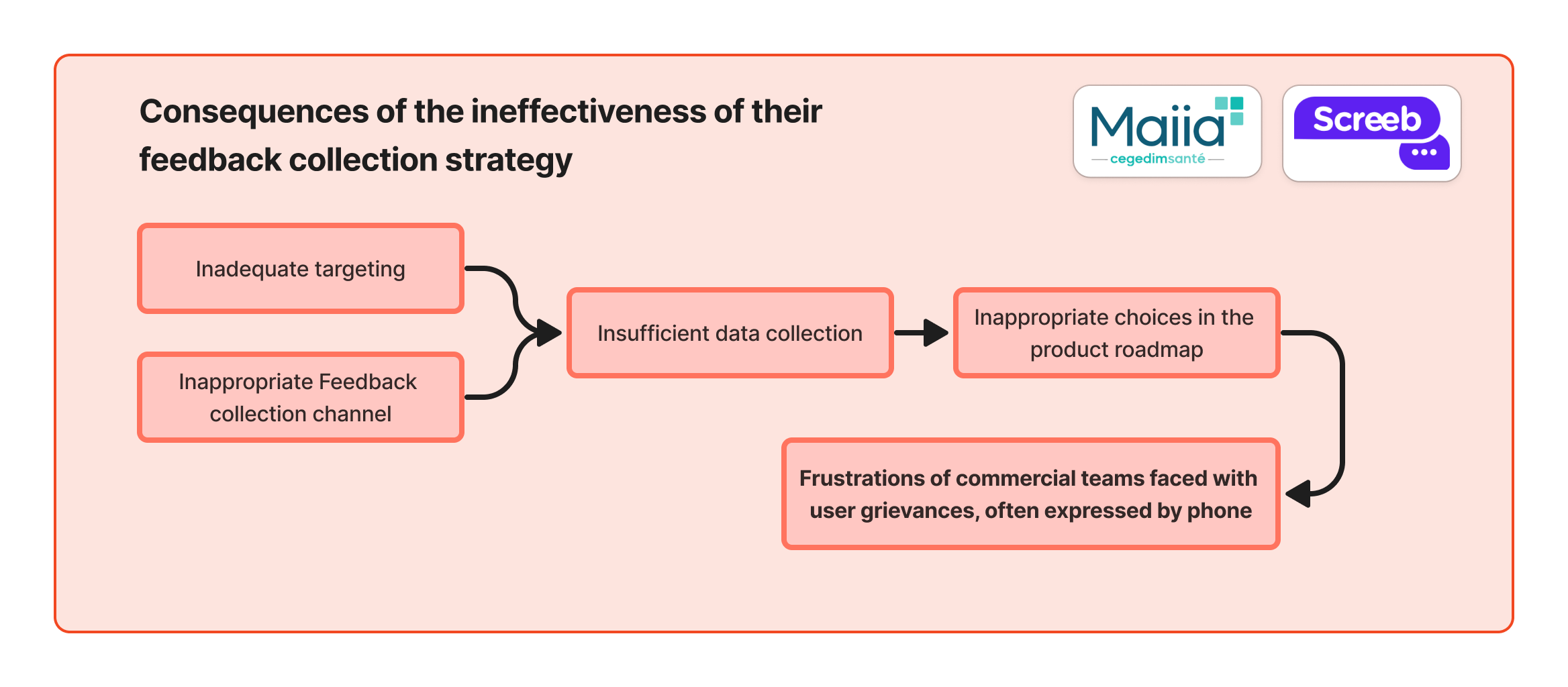
- Inadequate targeting: difficulty segmenting users based on their profile or usage context.
- Inappropriate collection channel: email surveys get a low response rate since most users prefer the app.
- Insufficient data collection to clearly identify users' friction points.
- Inappropriate choices in the product roadmap, not addressing users' real needs.
- Frustrations among sales teams dealing with user complaints, often voiced by phone.
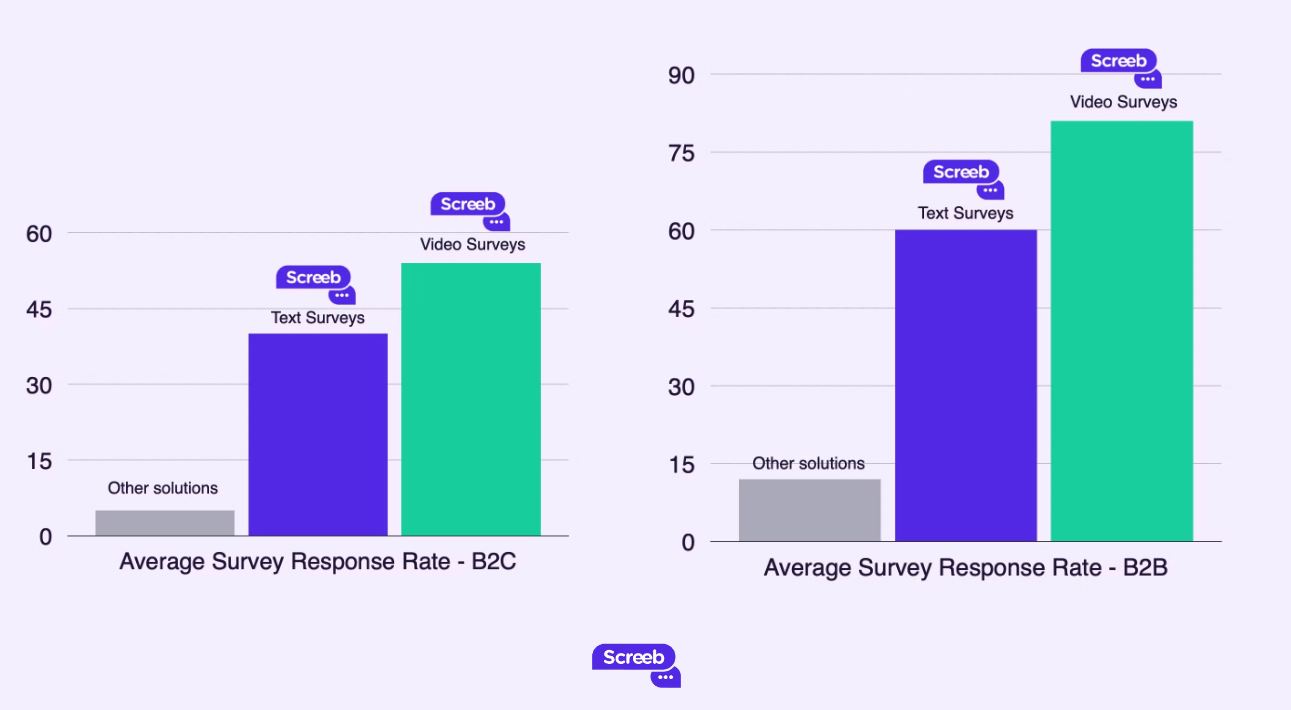
Tip: to maximize the effectiveness of your feedback collection, it's essential to know your users' preferred way of interacting.
If a web or mobile app is at the core of your service, seriously consider an in-app feedback tool. Response rates for in-app feedback are significantly higher than those from email.
To solve this problem, Alexandre identifies several solutions:
- Segment user feedback more finely to ensure a relevant analysis.
- Make sure the people surveyed match the questions asked to improve the quality of the answers.
Second problem: the inability to measure the results of user feedback
The second major problem Alexandre's team faced was its inability to reliably measure the results of user feedback, whether positive or negative. The results were regularly influenced by the sales reps' subjective impressions, which biased the analysis.
The concrete Maiia example that illustrates the impact of flawed feedback analysis
A concrete example illustrates the impact of this problem on the company's organization and crisis management:
In response to a period of crisis, Maiia decides to launch a new feature on a Wednesday.
The very next day, several sales reps voiced their dissatisfaction with the usability of the new feature. Under pressure, the Product team decided to pull the feature, reverting to the previous version.
But what about the end users?
Without the ability to quickly and effectively measure end-user feedback, the team backtracked and removed a feature that end users might have liked.
Data-driven decision making
Second tip: when working with several departments with varied profiles, it's crucial to base your decisions on factual data rather than subjective opinions.
Choose a tool that lets you analyze your user feedback and extract key insights simply, quickly and efficiently!
Screeb's impact on this problem
After implementing Screeb, Maiia faces a new crisis situation, similar to the previous one.
This time, however, the Product team decided to react differently by urgently launching a customer satisfaction survey (CSAT) among users in order to base their decisions on objective data rather than subjective perceptions.
The results of this survey revealed that the dissatisfaction, as voiced by the sales reps and some users, was not as pronounced as it seemed:
- CSAT scores weren't particularly positive, but they were similar to those from the previous campaign;
- The negative comments relayed by the sales reps made up only a small percentage of overall feedback.
Thanks to these insights, the Product team was able to make an informed decision, based not on a small group of users, but on the majority of the feedback.
Third problem: insufficient quantity of feedback collected
To ensure high-quality feedback, Maiia was already using targeted feedback collection methods:
- Focus groups: this method generates data on user reactions and brings out a range of viewpoints.
- One-on-one interviews: one-on-one interviews gather detailed feedback on the user experience through open-ended questions
- Shadowing: this method reveals natural behavior and unexpected difficulties, offering valuable insights into the real user experience.
However, these approaches proved insufficient for collecting user feedback at scale. Combined with traditional email feedback tools, these methods were slow and cost a lot of time and energy for results that were often limited.
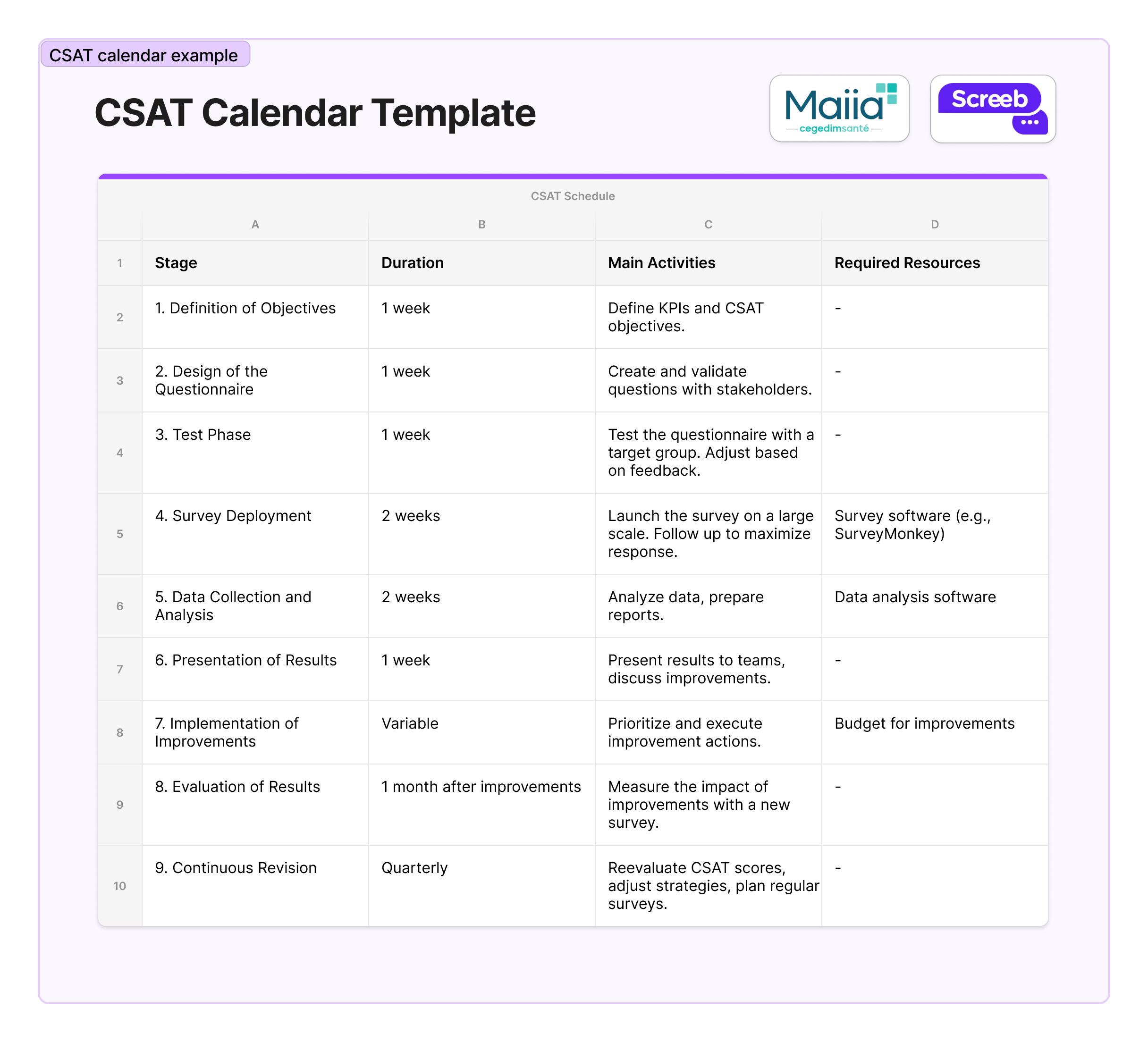
To extract key quantified insights and prioritize the product roadmap effectively, Alexandre needed to collect more feedback. To do that, he set up a CSAT schedule, for example.
Tip: like Alexandre, it's essential to mix different feedback collection strategies: combine the depth of one-on-one interviews with the breadth of multiple-choice surveys to enrich your data.
The solution
Given these three problems, Alexandre decided to transform the way Maiia collects user feedback and went looking for a solution that met these criteria:
- In-app feedback solution, suited to web and mobile apps
- Segment feedback collection by Cegedim Santé's different products and by target audience;
- A solution that puts data analysis at the heart of the product, measuring both quantitative and qualitative results
- A solution that can handle different types of data collection
- A solution that can collect user feedback at scale and centralize it
Maiia's final choice: Screeb
After evaluating several platforms on price, features, and user interface, Alexandre and his team chose Screeb for several reasons:
- Top performance for in-app feedback collection on web and mobile;
- An intuitive, enjoyable product UX;
- Competitive pricing, often cheaper for comparable features;
Screeb lets Alexandre quickly collect both quantified and qualified feedback on the same product. Integrated with ProductBoard, which centralizes all insights and user feedback, Alexandre built an effective feedback loop strategy:
- Creating in-app quantitative surveys with Screeb;
- Segmenting user feedback by satisfaction and needs;
- Syncing with ProductBoard and the CRM;
- Scheduling one-on-one interviews through Screeb to better understand user needs;
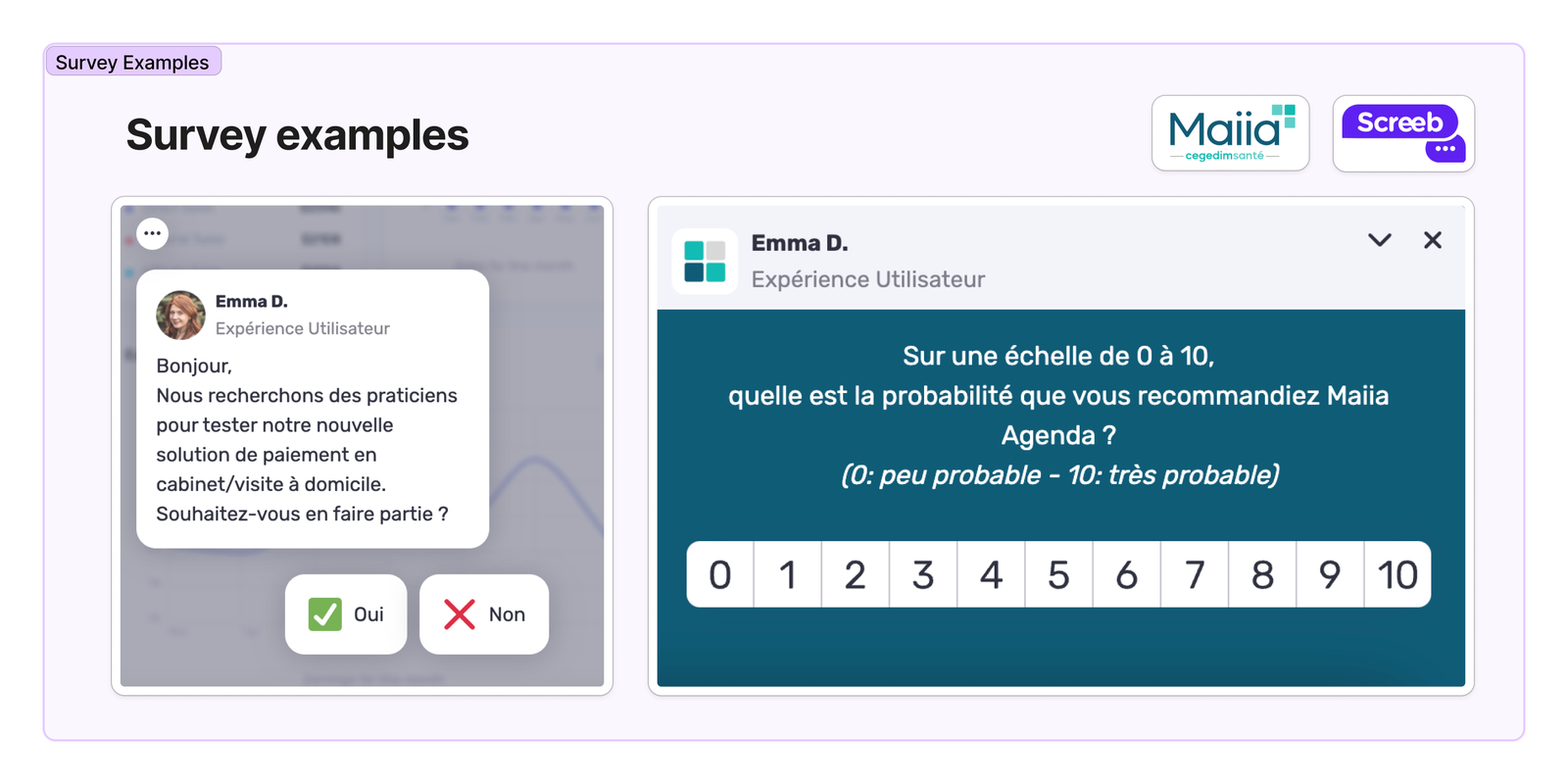
Examples of surveys run at Maiia:
The results
Impact #1: a crucial tool for product decisions
To illustrate this impact, nothing beats an example told by Alexandre.
“During a busy period, we had to build a feature quickly without doing any Product Discovery, relying on what we already knew.
Faced with two competing proposals, we didn't know which one was the better fit.
So we were able to quickly target users and ask them which option they preferred through Screeb, and decide which version to build.”
— Alexandre Dandler, UX/UI lead at Maiia
Impact #2: better choices in prioritizing the product roadmap
By collecting a large amount of user feedback and easily extracting the key insights, Screeb now lets Maiia prioritize its product roadmap more effectively, basing it on facts rather than opinions.
Conclusion
Alexandre Dandler's story shows how important good feedback collection is, and therefore how important it is to choose a tool suited to your audience. By moving from traditional, ineffective feedback methods to a dynamic, data-driven approach, Cegedim Santé not only improved its product development cycle but also strengthened its commitment to meeting the changing needs of healthcare professionals and their patients.
Adopting a feedback collection strategy isn't just an option, it's a necessity for staying relevant and responsive in a competitive market. As we move forward, the ability to respond to user feedback will keep defining tomorrow's leaders, especially in sectors as critical as healthcare.