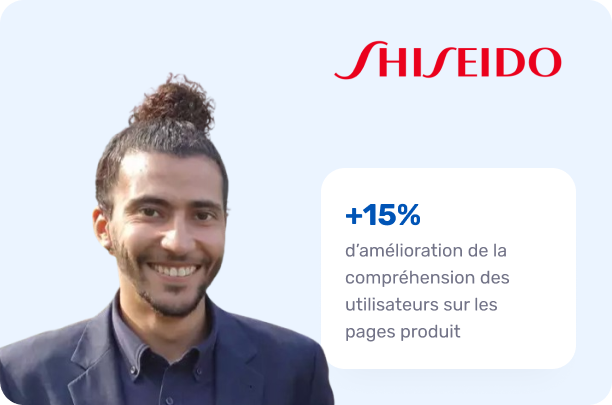
At Shiseido, a global leader in cosmetics, Nourredine Abbes, UX Researcher, took on a major challenge: optimizing the understanding of consumer expectations to refine product and marketing decisions. This case study explores the issues tied to fragmented customer feedback collection and its impact on the development of product ranges. It details how Nourredine and his team rethought their approach by integrating innovative tools and methods to structure and use these insights more strategically. Thanks to this transformation, Shiseido now has a sharper view of its customers' needs, strengthening the effectiveness of its product roadmap and its marketing campaigns.
Summary of Shiseido's product strategy
Problems Shiseido faced:
- Lack of visibility into the user experience: Shiseido's product team struggled to understand users' expectations and frustrations precisely. Quantitative data alone couldn't explain some of the behaviors observed on the e-commerce site.
- No continuous, structured feedback: the methods in place before Screeb (one-off interviews, customer service data) couldn't capture user feedback in real time and at scale.
- Difficulty prioritizing product improvements: without precise insights into users' motivations, the team relied on assumptions to set its priorities, which could lead to costly, non-essential redesigns.
Solutions implemented:
- Adopting Screeb: Shiseido deployed surveys directly on its e-commerce site to gather real-time insights without disrupting the user experience.
- Setting up a continuous feedback strategy: thanks to Screeb's segmentation and analysis capabilities, the team built a process that continuously feeds product decisions with user insights.
- Aligning teams around user data: the feedback collected broke down silos between UX Research, marketing, and the product team, making decisions easier to base on concrete feedback.
Notable impacts:
- Optimizing product pages: adding new product information (texture, skin type, key benefits) was guided by Screeb insights, leading to a +15% increase in user satisfaction with the clarity of product pages.
- A better understanding of behavior: Screeb surveys revealed that product images played a key role in the purchase decision, but that their format and variety were insufficient. The result: a targeted redesign of product visuals, co-built with the marketing team.
- A direct business impact on conversion: Screeb insights made it possible to identify priority optimizations for the purchase journey, reducing friction points and improving the overall experience.
The context
Shiseido, a leading name in beauty, invests heavily in improving the user experience on its e-commerce site. Nourredine, who leads UX Research, played a key role in setting up a feedback collection strategy to better understand consumer expectations.
Before integrating Screeb, the team relied mainly on:
- quantitative analyses through Content Square and Google Analytics;
- one-off feedback from customer service;
- a few user interviews organized on an ad hoc basis.
Despite these efforts, several challenges persisted:
- quantitative data alone couldn't explain certain user behaviors;
- feedback was fragmented and hard to use at scale;
- there was no structured process for collecting and using user insights continuously.
The challenge
Problem one: no continuous feedback on the user experience
Shiseido's product team didn't have an effective channel for continuously capturing user feedback on their purchase journey.
The absence of structured feedback collection caused several major problems:
- A lack of visibility into user expectations: it was impossible to understand the precise reasons behind cart abandonment or exits from product pages.
- Product decisions based on assumptions: redesigns were often carried out without user validation, increasing the risk of ineffective optimizations.
- One-off, costly feedback collection: user interviews and studies were too far apart and didn't allow dynamic tracking of customer needs.
- Actions not aligned across Product, UX, and Marketing teams: each team worked with its own priorities, without a shared view of user expectations.
Tip: to maximize the effectiveness of your feedback collection, favor an in-app tool built into the user experience. Unlike email surveys or one-off interviews, continuous feedback lets you quickly identify friction points and adapt the product roadmap accordingly.
Problem two: difficulty explaining certain user behaviors
Quantitative data showed trends, but didn't explain why users acted that way.
Despite in-depth analysis through Google Analytics and Content Square, some trends remained unexplained:
- Why did users spend a long time on a product page without adding to cart?
- Why was the abandonment rate high when engagement on the site seemed strong?
- Why did some optimizations based on quantitative data have no effect on conversions?
Without qualitative data, it was impossible to confirm or disprove hypotheses about these behaviors.
This second problem had concrete consequences for Shiseido:
- Optimizations that lacked impact: some product changes didn't have the expected effect on the customer experience.
- Wasted time and resources: costly redesigns were carried out without prior validation of user needs.
- Difficulty prioritizing actions: it was impossible to know which parts of the experience needed improvement first.
Second tip: pair qualitative feedback with analytics data. Data shows what happens, but user feedback explains why. By combining the two, you get a clearer view of friction points and opportunities for improvement.
Problem three: a lack of alignment between Product, UX, and Marketing teams
The absence of a shared user feedback reference limited collaboration between teams.
At Shiseido, several departments had a key role in improving the user experience, but didn't always share the same vision:
- UX Research collected user insights, but struggled to get its recommendations adopted by the product team.
- Marketing managed product visuals and descriptions, with no direct feedback on their real impact on users.
- The product team prioritized changes based solely on business and quantitative KPIs.
This lack of coordination led to a disconnect between user needs and the actions put in place.
Tip: create rituals for sharing user insights between teams. A central repository and quarterly meetings help align Product, UX, and Marketing around the same priorities.
The solution
Shiseido integrated Screeb to structure and automate user feedback collection, enabling better product decisions. The goal was to solve the problems identified by setting up a feedback process that is continuous, targeted, and actionable.
The three areas of improvement Screeb brought:
1. Continuous, integrated feedback collection
Before Screeb, Shiseido struggled to capture users' opinions in real time. Thanks to the integration of surveys, the team was able to:
- deploy micro-surveys on product pages to measure how clear the information is;
- ask visitors at the moment of cart abandonment to understand what holds them back from buying;
- collect feedback in the checkout to identify friction points.
Result: real-time tracking of user perceptions, making it possible to quickly adjust the online experience.
2. A better understanding of behavior through qualitative insights
Analytics data wasn't enough to explain some of the trends observed. Screeb made it possible to complement quantitative data with contextualized user feedback:
- detecting the need for more precise product information (compatibility, benefits, texture);
- identifying the key role of images in the purchase decision, leading to a redesign of product visuals;
- validating hypotheses thanks to customer verbatims, avoiding unnecessary and costly redesigns.
Result: product page optimization based on tangible data rather than guesswork.
3. Stronger alignment between UX Research, Product, and Marketing
Before Screeb, each team worked with its own data and priorities. The tool made it possible to create a single reference and improve collaboration:
- setting up a feedback repository, accessible to Product, UX, and Marketing teams;
- organizing rituals for sharing insights, helping align priorities;
- using customer verbatims to justify and defend product decisions internally.
Result: faster decision-making, better aligned with users' real expectations.
The results
Shiseido was able to structure its feedback strategy and optimize its user experience with measurable results.
- +15% improvement in user satisfaction on product pages. The redesign of product pages, based on Screeb insights, made it possible to give visitors clearer, more relevant information.
- Better conversion thanks to targeted UX adjustments. Qualitative insights revealed barriers to purchase that weren't visible in quantitative data alone, making it possible to prioritize the highest-impact changes.
- Time and efficiency savings for the Product and UX Research teams. Automated, continuous feedback collection reduced reliance on one-off, time-consuming studies, enabling more agile decision-making.
- Stronger alignment with marketing and customer service. Thanks to the 300 customer verbatims collected every month through Screeb, internal discussions are now based on concrete data rather than assumptions.

Conclusion
By rethinking how it collects and uses consumer insights, Shiseido took a key step in optimizing its product and marketing strategy. By putting data at the heart of its decisions, the team not only improved its understanding of customer expectations, but also became more responsive and efficient in developing its ranges. This transformation illustrates the importance of a structured, proactive approach to meeting the challenges of a constantly changing market. With this new momentum, Shiseido positions itself more than ever as a brand that listens to its consumers, able to anticipate and respond precisely to their needs.