

At Doctolib, measuring the patient experience isn't just about an end-of-journey satisfaction score. Behind every piece of feedback lies a relationship with health that carries real emotion — people don't come to a medical app the way they'd approach any other product; they arrive with expectations that can touch on fear, stress, and deeply personal stakes. "In healthcare, you're not just looking for an app that works well: you're touching on fears, on stress," says Naima Zakaria, Go-To-Market Manager, Patient. "That's why measuring satisfaction goes beyond what other industries have to deal with." This is the challenge Doctolib took on, rethinking from the ground up how it collects and acts on patient feedback across its three markets: France, Germany, and Italy.
The Doctolib customer story, on video
The real problem: partial, manual patient feedback
For a long time, patient feedback collection at Doctolib relied on a largely manual setup. "We had a handcrafted method: we built all our surveys by hand, and every time we needed to launch one, we depended on a technical roadmap," says Maud Laisney, Product Manager. In practice, this meant no business team could launch a survey on its own initiative to test a hypothesis or check user sentiment: they first had to secure a slot on a technical roadmap that was already packed.
This constraint had a side effect more insidious than a simple lack of responsiveness: it reduced the whole feedback setup to its lowest common denominator, an NPS triggered only at the very end of the online appointment-booking funnel. A choice that, mechanically, only captured patients whose journey had gone well. Patients who'd had a harder experience — often the ones with the most valuable insights for prioritizing product improvements — remained largely invisible. As Maud Laisney puts it: "We were only capturing positive feedback, at the end of the booking journey. Our feedback was skewed, and we lacked visibility into the full experience."
So the real problem to solve wasn't just a tooling one: it was giving autonomy back to every team that needed patient feedback day to day, without losing brand and communication consistency across the whole product.
A structured rollout across 3 countries
At Doctolib, the use of Screeb quickly expanded well beyond the classic satisfaction survey. Today it covers three main, complementary use cases: recurring surveys, which measure overall and feature-level satisfaction to continuously feed the product roadmap; ad hoc surveys, used for user research and design testing; and, more recently, in-app messages, which highlight specific features directly within the app.
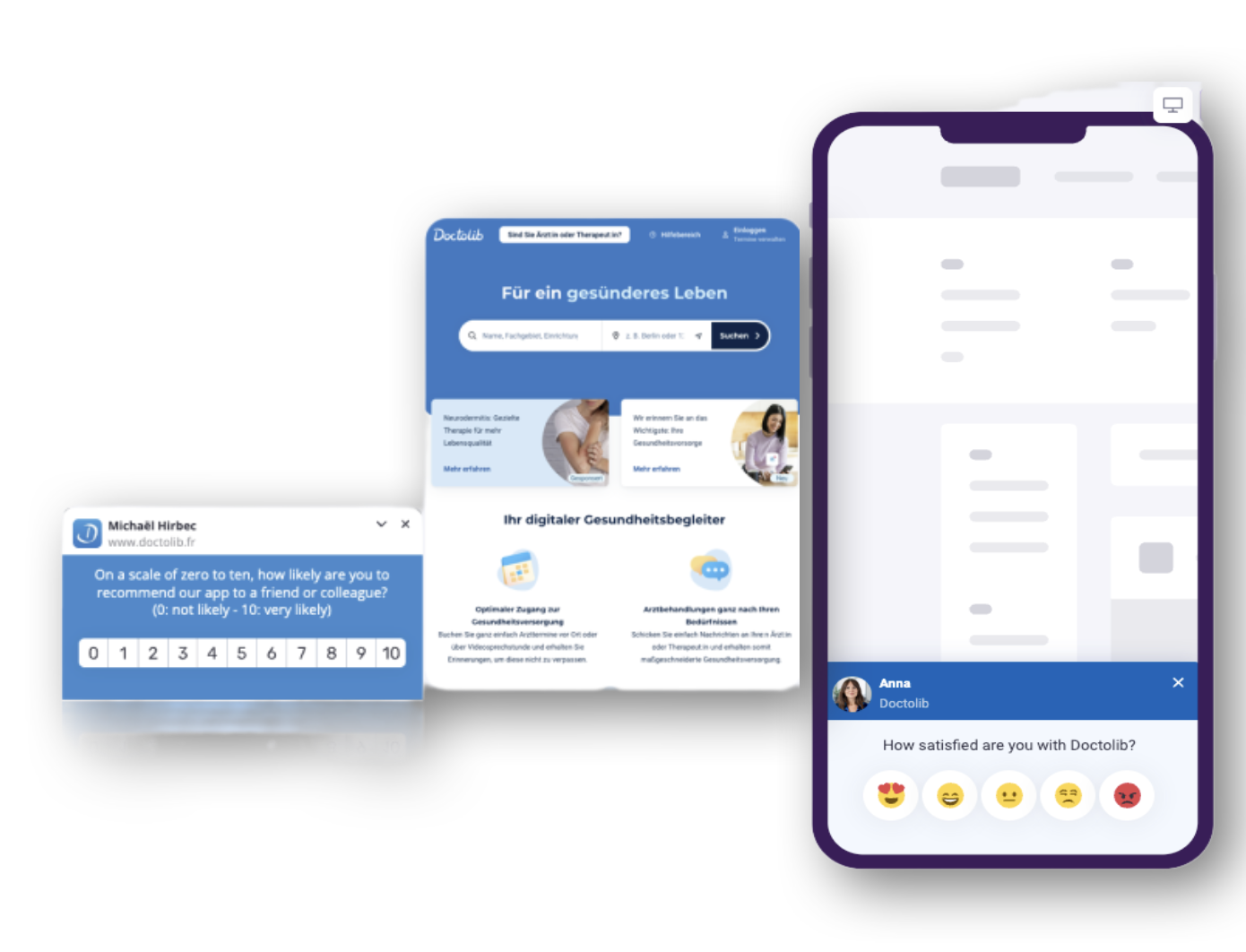
This diversity of use cases required an organization to match. Doctolib structured its Screeb workspaces by country — France, Germany, Italy — each with a separate production and test environment. In practice, local teams design, test, and iterate on their surveys independently in their test workspace; the Global Patient team then takes over for production, making sure each survey follows the brand's communication guidelines. Franziska Maria Bauschert, Product Marketing Manager, sums up this balance well: teams remain "fully autonomous to create, test, and iterate on their surveys," while her team keeps a hand on "overall coordination and consistency."
This autonomy has turned the tool into a reflex for a growing number of teams, well beyond the Global Patient team that originally drove its adoption: the Prevention team, each country's B2C teams, and the Product and Design teams for user research and design testing.
The results, in practice
Beyond internal adoption, Screeb's impact at Doctolib is most concretely felt on three fronts: the ability to evolve a product based on real feedback, patient engagement beyond simple measurement, and the brand's external visibility.
The clearest example is probably the launch of the Health tab. Even before talking about post-launch feedback, Screeb was first used to recruit early test users to co-build the feature with them. Once the tab launched, feedback collected via Screeb revealed that many patients found the vocabulary too technical, too medical, not accessible enough — a signal Doctolib would likely have missed with a generic end-of-funnel NPS. The team was able to rewrite the feature's wording as a result. As Naima Zakaria tells it: "Patients told us some of the words in the Health tab were too technical, too medical. Thanks to Screeb, we rewrote the wording so it would really speak to them."
Product Tours, meanwhile, have let Doctolib go beyond simple measurement to actively guide usage. Several use cases have been tested internally — a support message during account creation, an onboarding Product Tour after signing up on the mobile app, and, more recently with the SEO team, a targeted prompt inviting users to add Doctolib as a preferred source on Google.
Finally, it's on external visibility that the impact is clearest. Monthly feedback across all features now lets Doctolib continuously adjust its product roadmap. But Screeb has also been used to guide patients outward: prompting them, at the right moment, to leave a review on the App Store or Trustpilot. The result exceeded the team's expectations:
"Screeb helped us multiply patient feedback and the number of App Store and Trustpilot reviews by 20."
— Naima Zakaria, Go-To-Market Manager, Patient, Doctolib
Lastly, the expansion into the Italian market illustrates how well Doctolib has adapted its use of Screeb to contexts very different from its historic French market, using the tool both to better understand Italian patients' expectations and to engage users already on the platform.
More autonomy for teams, a long-term collaboration
Two factors tipped the balance in Screeb's favor. First, the tool's UX and ease of use: a decisive criterion given the ambition to make non-technical teams autonomous in creating surveys, not just data or product experts. Second, a stack-consolidation logic that paid off over time: at that point, Doctolib was supplementing its survey solution with a third-party tool dedicated to translation, automation, and categorization of customer feedback. That tool has since been dropped, as Screeb built those capabilities directly into its own product suite.
Since then, the relationship between the two teams has played out on two levels: day-to-day operational support, which Doctolib finds highly responsive for everyday questions; and a more strategic weekly ritual, where Doctolib shares its vision, roadmap, and the half-year's key initiatives with the Screeb teams. It's in this setting that the two teams co-build how the tool can support the specific challenges of each market.
What's next: moving from reactive to proactive
Even today, Screeb is mostly used reactively at Doctolib. Naima Zakaria sees a natural evolution of this usage in the coming months, toward a dedicated Screeb roadmap, with a regular, planned spotlight on certain features or use cases. "We've gone from a reactive to a proactive use of Screeb," she sums up.
For Maud Laisney, this shift shows up very concretely in her day-to-day work: she now spends less time waiting for a slot to free up on the technical roadmap to launch a survey, and more time figuring out where and how to go find useful feedback.
"Screeb has helped put patients at the heart of every product and marketing decision — not just in our team."
— Naima Zakaria, Doctolib
Frequently asked questions
Why isn't an end-of-journey NPS enough to measure the patient experience?
Because it mostly captures users whose experience went well. Feedback from patients who had a harder journey — often the most useful for prioritizing product improvements — is largely under-represented.
How does Doctolib organize Screeb across 3 different countries?
Through separate workspaces per country (France, Germany, Italy), each with a production and a test environment, letting each local team be autonomous while keeping centralized coordination through the Global Patient team.
What exactly is a Screeb Product Tour?
A message or guided sequence displayed directly within the product to support the user — for example, a support message during account creation, an onboarding flow after sign-up, or a prompt to take a specific action.
What measured impact has this had on Doctolib's public reviews?
The volume of reviews and comments collected on the App Store and Trustpilot has multiplied by 20 since adopting Screeb.
Is Screeb suitable for a sector as regulated as healthcare?
Yes — and Doctolib has proven it for over three years. Screeb is a French company with French capital, hosting 100% of its data in France (with Scaleway and OVHcloud) and relying on sovereign AI, developed by the French company Mistral AI: no data passes through a foreign black box subject to extraterritorial law such as the US Cloud Act. The result: full GDPR compliance, without exposure to the extra-EU legal reach of American providers — a prerequisite for the most sensitive sectors, starting with healthcare.
Conclusion
By moving from a handcrafted, centralized survey setup to an autonomous, country-structured patient feedback program, Doctolib has brought the patient's voice into user research, product, and marketing all at once. The result: a roadmap continuously driven by real feedback, and a 20x increase in public reviews.
Want to give your teams the same autonomy over product feedback?

%20(1).png)